You hired a bookkeeper because the books were behind. Six months later, the reconciliations are tidy, yet you still can't answer the questions that keep you awake: Can we make payroll? When will the largest customer pay? Can we afford the new hire? What happens if sales soften?
That isn't a bookkeeping problem. It's a management-information problem. The right finance support depends on the decisions your business must make now, not on a turnover bracket or a vague idea that a CFO is only for large companies.
When a Bookkeeper Is Not Enough
A founder I've worked with hired a bookkeeper to keep transactions current. The bookkeeper did exactly that. Bank accounts were reconciled, invoices were entered and expenses were coded. But the founder needed a rolling 13-week cash forecast showing tax, payroll, supplier commitments, customer receipts and the effect of a planned expansion.
The bookkeeper could tell her what had happened. Nobody could tell her what was likely to happen next. That gap forced her to delay a hiring decision, chase customers manually and discover a tax obligation far too late.

A bookkeeper protects transaction accuracy. An accountant turns records into compliant accounts, tax work and useful interpretation. A CFO converts financial information into forecasts, scenarios, funding decisions and performance management. Founders often choose the cheapest role because the immediate pain looks like data entry. That choice becomes expensive when nobody owns cash visibility.
Core rule: The quality and speed of your financial information matter more than the size of your business.
A small business with uneven receipts, tax exposure or a major growth decision may need more senior financial thinking than a larger but stable operation. If you need practical accounting support for small businesses, start by identifying the decisions your current reports cannot support. Wisely's accounting services can sit within that broader review of records, reporting and workflow.
What Each Role Actually Does Day to Day
The simplest distinction is this: bookkeeping records the past, accounting explains and formalises it, and CFO work prepares the business for decisions ahead.
| Role | Primary Output | Key Question They Answer |
|---|---|---|
| Bookkeeper | Reconciled transactions, payables, receivables, payroll inputs and GST records | “Are the records complete and accurate?” |
| Accountant | Tax work, statutory accounts, financial statements and financial interpretation | “What do the numbers mean, and are we meeting our obligations?” |
| CFO | Rolling forecasts, scenarios, KPIs, funding plans and capital-allocation advice | “What should we do next, and can we fund it?” |
A bookkeeper should give you confidence that bank transactions, invoices, expenses and payroll inputs are captured correctly. They can help identify overdue invoices and maintain a disciplined month-end process, but they won't automatically model whether a new project will absorb cash before it generates receipts.
An accountant becomes essential when records need adjustment, interpretation or preparation into compliant financial statements. Under New Zealand's Companies Act framework, every company must keep financial records for seven years, and the board remains responsible for ensuring those records are maintained and readily available, as explained by the Companies Office record-keeping guidance. If you're preparing to prepare financial statements for sale, accurate records are only the starting point.
A CFO earns their place when management needs an integrated view of liquidity, profitability, risk and growth. That means answering questions about hiring, pricing, debt, capital, customer concentration and downside scenarios before the decision becomes urgent.
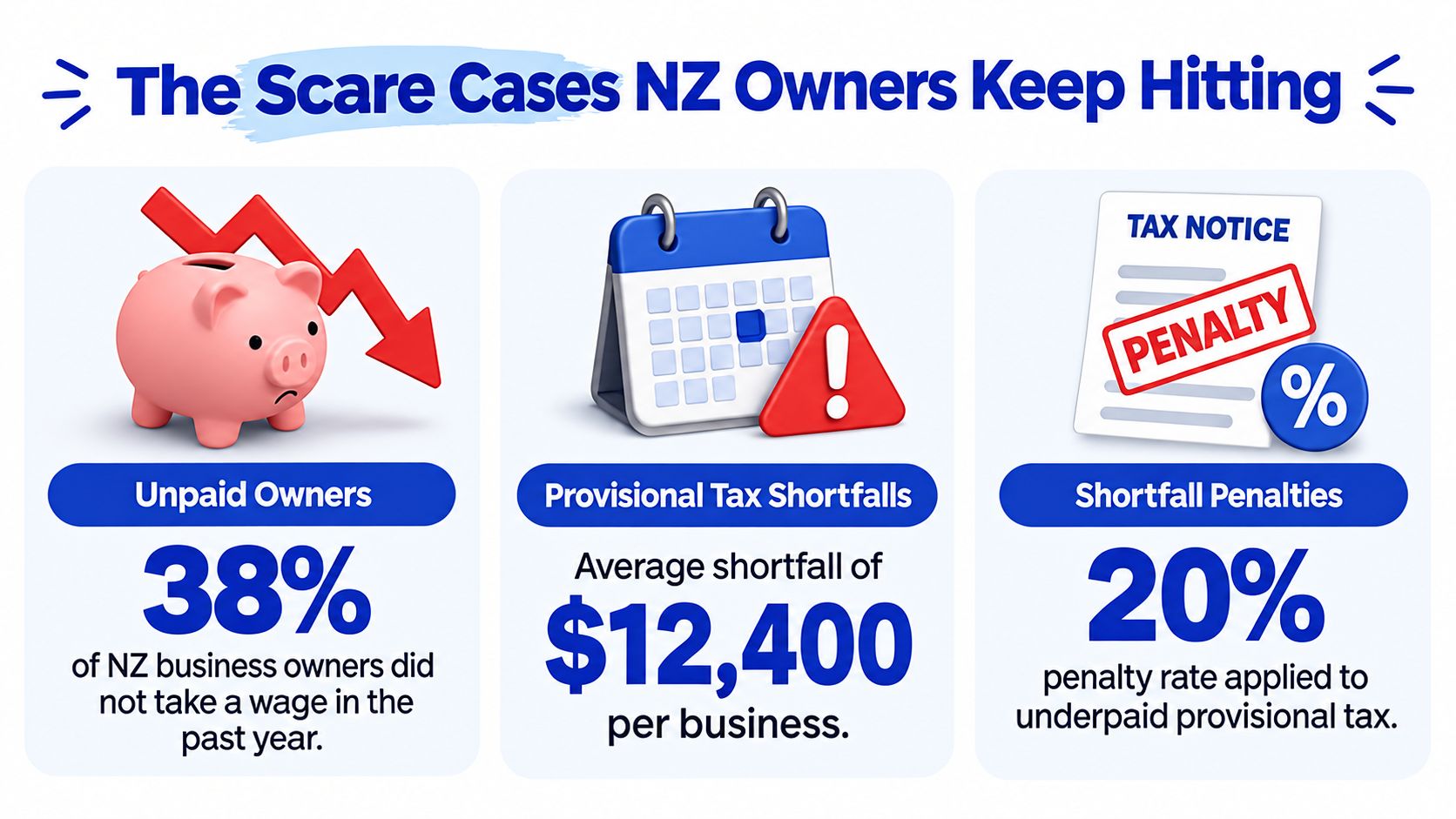
The Scare Cases NZ Owners Keep Hitting
A clean profit and loss statement doesn't guarantee spendable cash. Receivables may be unpaid, stock may be tying up funds, tax may be due and debt repayments may arrive before the next customer receipt.
Xero-reported New Zealand research found that 46% of business owners and 60% of sole traders were not paying themselves to keep their businesses operating, while 52% had raised prices to address cash-flow challenges. The same figures show why owner drawings and accounting profit aren't reliable substitutes for a cash plan. Read the Xero research on NZ owner cash-flow pressure for the underlying findings.
The frightening part is that the failure often looks gradual. The owner defers their own pay, suppliers wait longer, tax money stays in the operating account and the overdraft becomes normal. A bookkeeper can keep the ledger accurate, but accuracy alone won't tell you whether next month's obligations can be funded.
Inland Revenue also warns that tax shortfalls can attract penalties. The shortfall penalty rules set penalties at 20% for failing to take reasonable care, 40% for gross carelessness and 100% for an abusive tax position. Reliable records reduce preventable errors, but forward planning is what stops an owner confusing a healthy bank balance with money available to spend.
Decision Triggers That Tell You to Escalate
Don't wait for a revenue milestone. Escalate when the business starts making decisions without dependable answers.
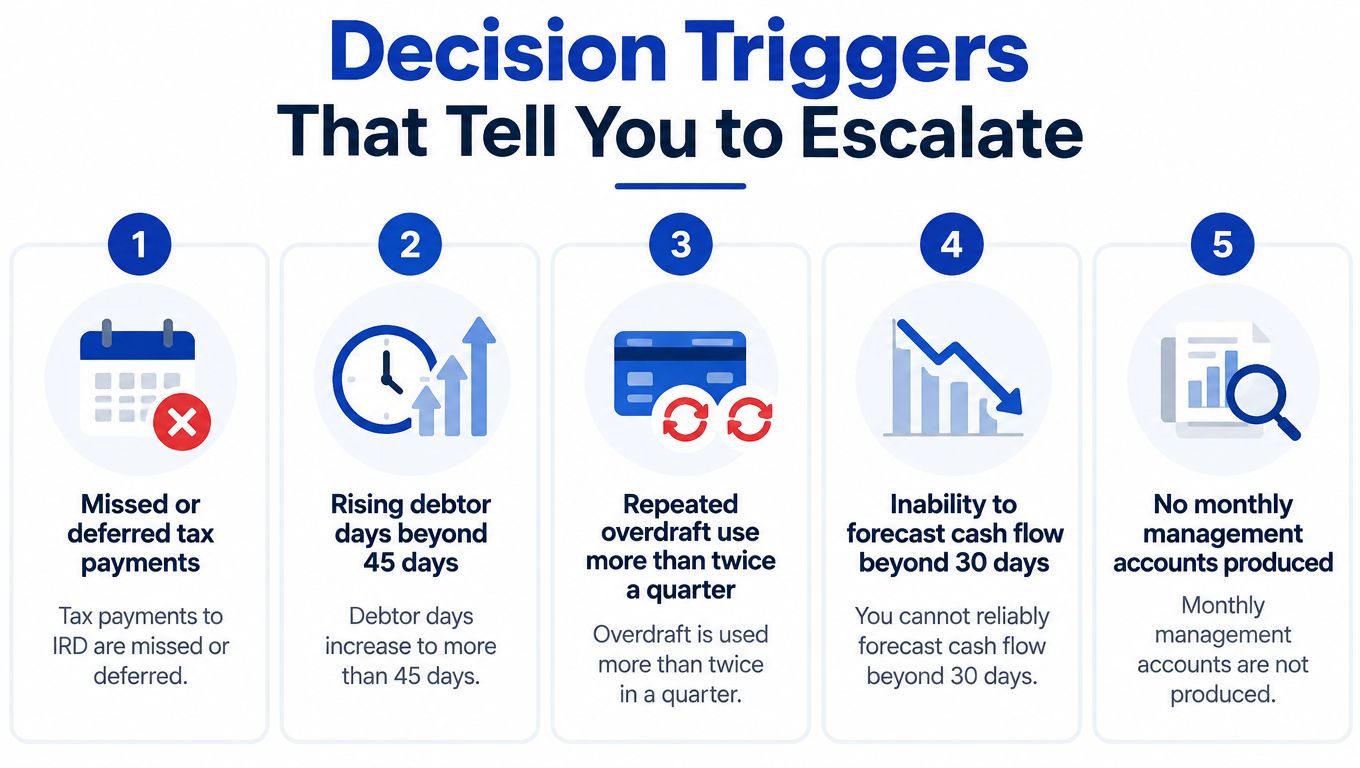
Use these triggers as a practical test:
- Tax payments are missed or deferred: Bring in an accountant immediately, then ask for a forecast of GST, payroll and income-tax commitments.
- Debtor days are rising: A bookkeeper can maintain aged receivables, but management needs a collections plan and a cash impact assessment.
- The overdraft keeps returning: Ask a CFO-level adviser to identify whether the cause is margin, timing, debt structure or uncontrolled spending.
- You can't forecast beyond the near term: Build a rolling cash model linked to payment dates, supplier terms, payroll and tax.
- Monthly management accounts don't exist: You can't manage margin, working capital or performance with year-end information alone.
The test is not whether someone can produce a report. It's whether you can answer, quickly and confidently:
- What cash is committed before it arrives?
- Which customers create the greatest collection risk?
- What happens if sales fall under the current plan?
- Which costs can be paused without damaging delivery?
- Can the business fund its next major decision?
If those answers aren't available, virtual CFO support is more relevant than asking a bookkeeper to process transactions faster.
Why the Missing Role May Be a Systems Adviser
Many founders respond to weak visibility by hiring a more senior finance professional. That can be the wrong first move. If invoicing, payroll, expenses, project tracking and bank data sit in disconnected systems, every finance role spends time assembling information instead of interpreting it.
MBIE research found that 51% of New Zealand businesses believe they would benefit from using more digital tools, while 48% aren't as digitally enabled as they could be, according to its research on digital capability among NZ businesses.
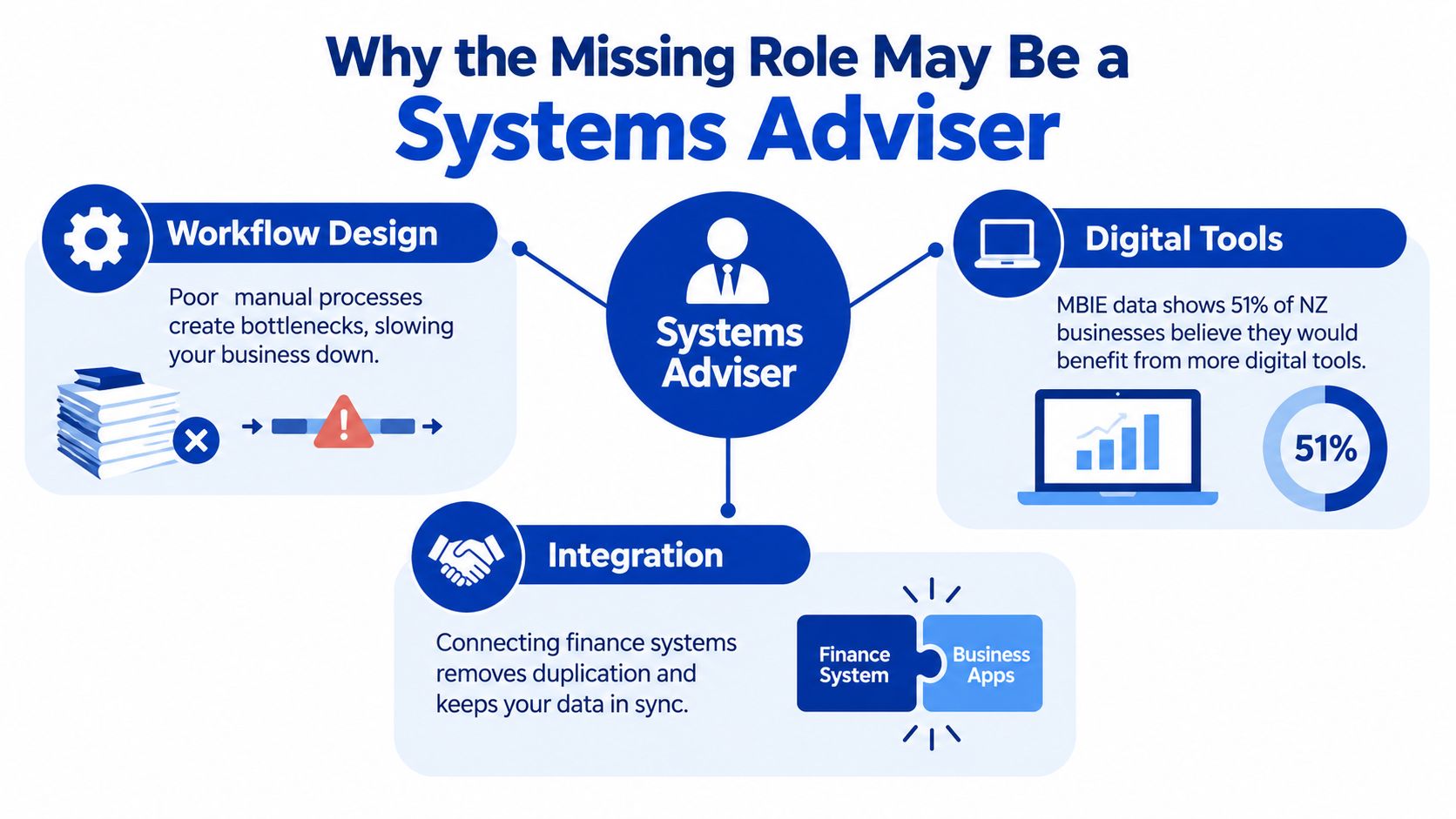
The missing capability may be a systems-and-data adviser who maps how a sale becomes an invoice, how an expense gets approved, how payroll information is checked and how financial data reaches management. Better workflow design removes duplicate entry and gives the accountant or CFO information they can trust.
There is evidence that digitising routine work can create operational value. MBIE's Digital Boost evaluation found that 23% of participating businesses reported spending less time on existing tasks, 17% reported increased revenue and 26% reported improved business resilience. Among businesses engaging with the programme weekly, 39% reported improved revenue, as detailed in the Digital Boost evaluation.
That doesn't mean automation replaces financial judgement. It means you should test the workflow before adding headcount.
A Workflow Automating Finance on monday.com With Wisely
A mid-sized New Zealand business may begin with a familiar mess. Sales raises an order in one system, operations tracks delivery elsewhere, invoices wait in an inbox, approvals happen through messages and the finance team builds a cash view manually at month end.
A better monday.com workflow starts with a WorkForm for finance requests. New invoices, expenses, supplier approvals and payroll changes enter one controlled route. Automated rules send each item to the right approver, flag missing information and record status without relying on a founder to chase every hand-off.
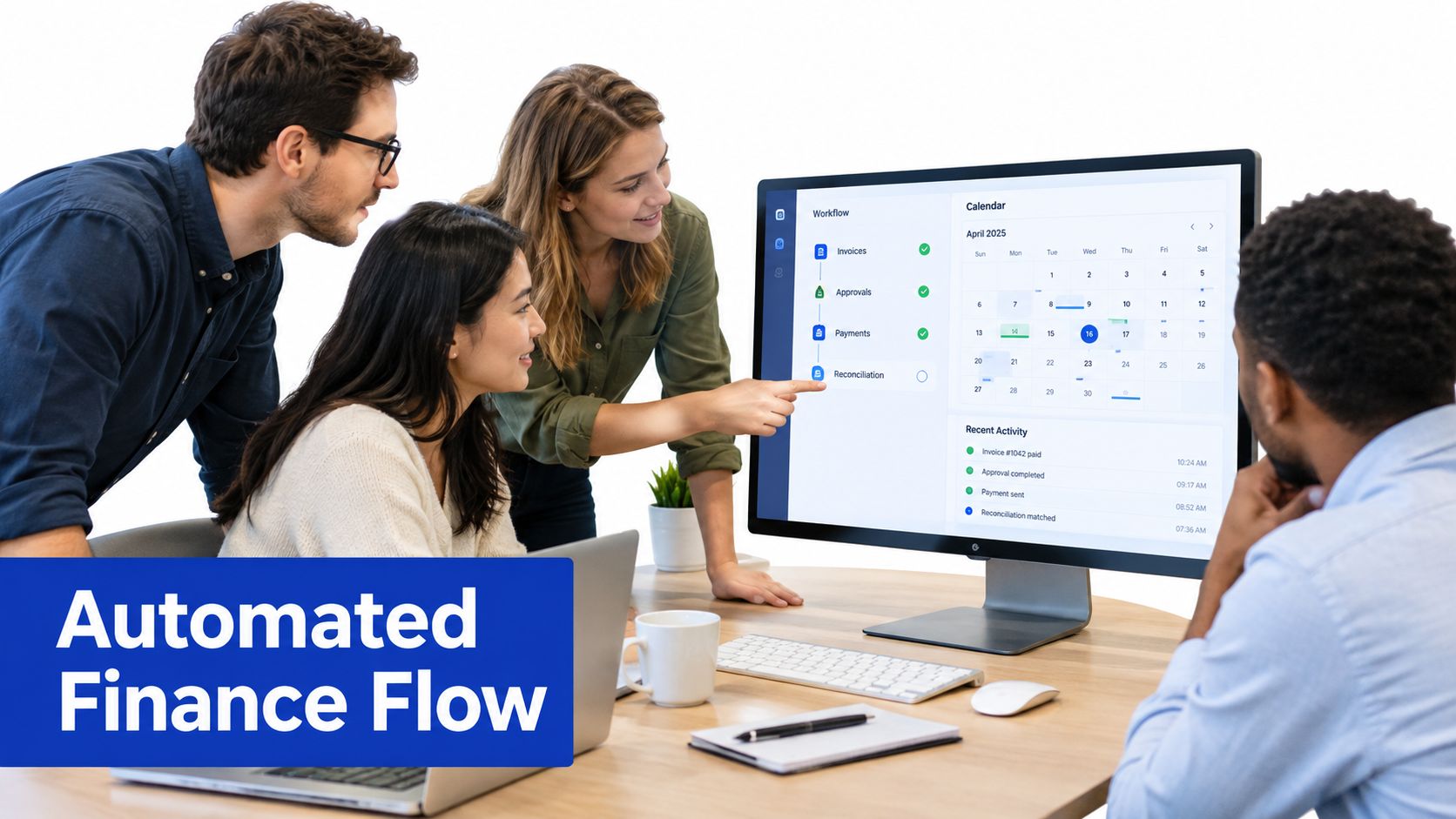
A connected board can track invoices, expenses, payroll inputs, tax-calendar dates and forecast assumptions. Finance sees exceptions rather than searching through messages. Operations sees which approvals are holding delivery. Sales sees whether commercial commitments have reached invoicing. Leadership gets a dashboard that supports cash decisions instead of a historical report that arrives after the decision.
Wisely is an advanced delivery partner of monday.com, providing implementation, health checks, training and ongoing optimisation, with delivery experience across New Zealand and Australia, as described in its monday.com partner service. Its monday.com consultancy can help translate the workflow into boards, forms, automations and reporting.
The result isn't a fictional promise of instant transformation. The practical gain is a clearer operating cadence. Capture happens closer to the source, approvals become visible, exceptions reach the right person and a finance adviser can spend more time on assumptions, scenarios and actions.
A Staged Pathway and What to Do Next
Use a staged model rather than buying the most senior title first.
Stage one is controlled bookkeeping. Capture every transaction, reconcile bank accounts, maintain aged receivables and payables, and keep payroll and GST inputs organised. Automate routine reminders and document capture where the process is predictable, but route exceptions to a human.
Stage two is accounting oversight. Add an accountant when the business needs tax planning, statutory reporting, adjustments, financial-statement preparation or interpretation. The accountant should work from a reliable source of records, not spend the engagement repairing avoidable data gaps.
Stage three is CFO decision support. Add CFO capacity when you need rolling cash forecasts, scenario modelling, KPI design, funding advice, capital allocation or board-ready reporting. The trigger is decision complexity, not status.
AI can assist with classification, reminders, document handling and workflow routing. MBIE's 2025 SME AI insights found that 94% of New Zealand SMEs were aware of at least one AI tool, while businesses reported using AI to improve efficiency, reduce administration and support daily operations. The same research highlights concerns about accuracy, privacy, security and trust, so finance professionals must retain control over tax treatment, exceptions and forecast assumptions. See the MBIE SME AI insights.
Start with three actions: map the current finance workflow, identify the cash questions you can't answer, and separate routine work from judgement work. Then choose the lightest combination of automation, bookkeeping, accounting and CFO support that closes those gaps.
Wisely helps businesses connect finance, operations and technology through monday.com workflow automation, accounting support and Virtual CFO services. Visit Wisely to request an assessment of your current finance workflow and build a practical path to faster, decision-ready cash visibility.