Your sales team closes a deal in a modern CRM, finance retypes the same customer details into an older accounting system, and the project manager still has to chase a spreadsheet before anyone knows what's been invoiced. The work gets done, but it's messy, slow, and dependent on people remembering to copy the right fields into the right place. That's the underlying cost of disconnected systems, not the software itself, but the friction between them.
For many SMBs, IT legacy system integration starts as a nuisance and turns into a business constraint. The warehouse can't see what sales promised, the service team can't see what finance approved, and leaders are making decisions from partial information. The fix isn't ripping everything out and starting again. It's building a practical bridge between what already works and what the business now needs.
The Growing Pains of Disconnected Systems
A lot of SMBs live with a split-screen operation. Sales works in one platform, finance in another, and operations in a third. The systems may each be useful on their own, but the hand-offs between them create delays, duplicate entry, and avoidable mistakes.
The pain shows up in small, everyday moments. Someone retypes an order, someone else corrects an address, and by the time the numbers line up, the customer has already asked for an update. That's not a technology problem in isolation, it's a workflow problem.
When the business moves faster than the systems
Older platforms usually stay because they still carry critical data or core processes. The trouble starts when new tools are added around them without a plan for how information will move. A flexible workspace like monday.com can help teams coordinate work, but if the underlying records still sit in a legacy ERP or finance system, staff end up switching between screens and trusting manually copied data.
Practical rule: if people are copying the same information more than once, the business is paying for the same work twice.
That duplication affects more than efficiency. It also weakens visibility, because leaders don't see a live picture of orders, stock, billing, or service status. In practice, that means decisions get delayed until someone reconciles the systems by hand.
The right response is to treat the mismatch as a process design issue, not just an IT one. Once you look at the workflow end to end, integration becomes less about tools and more about removing the gaps that slow the business down.
What Is Legacy System Integration
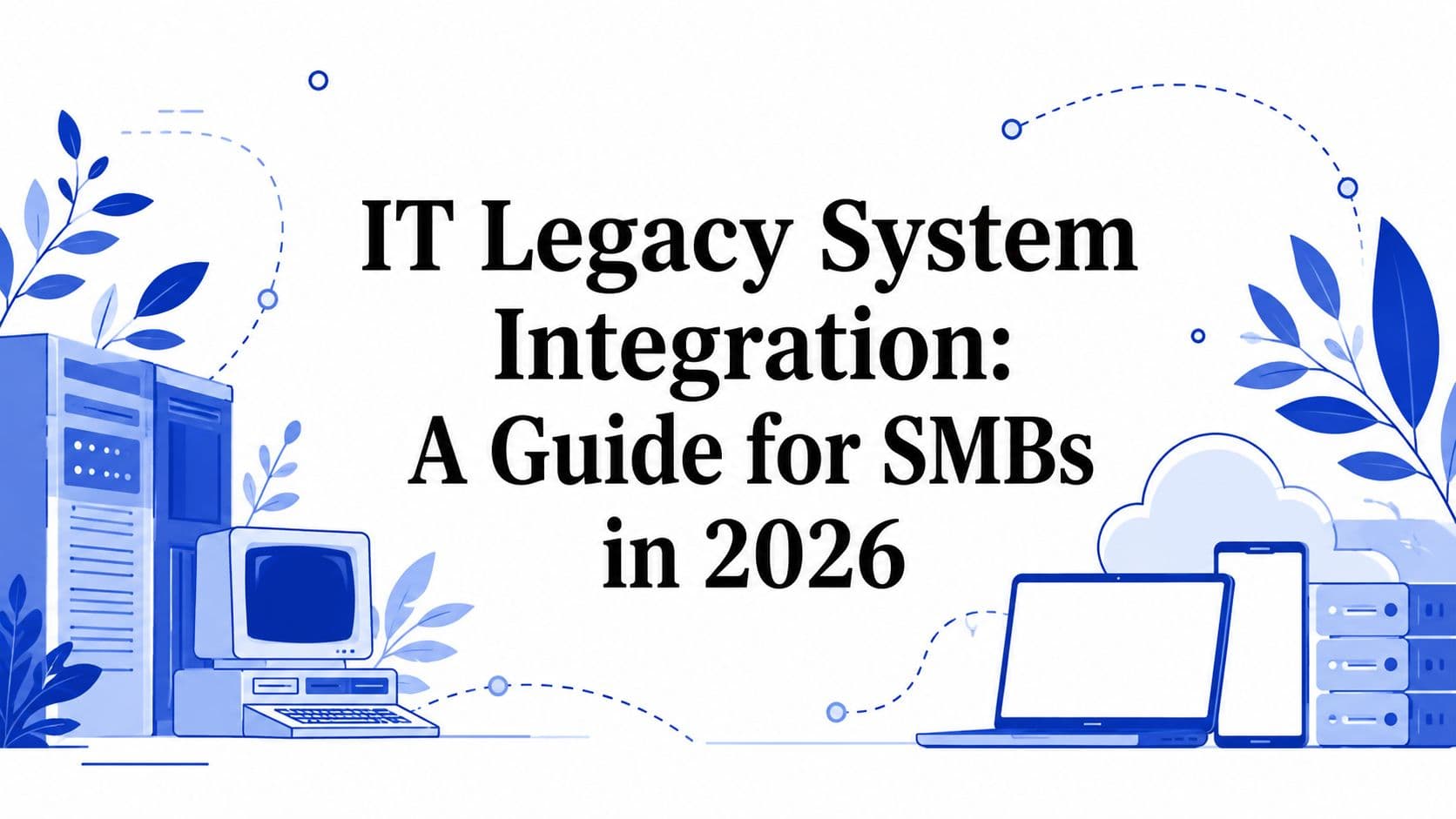
A legacy system in an SMB isn't necessarily old in the dramatic sense. It's usually the system that still holds key customer records, financial data, inventory logic, or case histories, but doesn't connect cleanly with newer cloud apps. It might be stable, familiar, and hard to replace because too many processes depend on it.
Consider the scenario of renovating a solid older house. The foundation is sound, the rooms still serve a purpose, but you want modern lighting, better controls, and maybe a smart thermostat. You can't plug new devices into outdated wiring and expect everything to work together. You need adapters, a central plan, and someone who understands both the old structure and the new appliances.
What integration actually does
Legacy system integration is the work of building those digital bridges. It connects systems so data can move between them without constant manual re-entry, while preserving the value already locked inside existing platforms. In the NZ public sector, that mindset is now explicit in government guidance, which says organisations should identify obsolete systems, build a complete and accurate register of data assets, know the full extent of systems and infrastructure, and plan migration around business needs, processes, and culture rather than software alone, as outlined in the government's legacy-system guidance.
That framing matters for SMBs too. Integration isn't a one-off technical patch. It's a business decision about how work should flow, who owns the data, and where the source of truth lives.
If you want a useful outside perspective on how structured change can be approached, Lynkro's approach to business transformation is worth a look because it treats connected systems as part of a broader operating model, not just an IT cleanup exercise.

Why the concept matters for SMBs
SMBs rarely have the luxury of replacing everything at once. They need to protect what already works while reducing the manual overhead around it. Integration is the middle path. It lets older systems keep doing their job while modern tools, dashboards, and automation layers make the business easier to run.
A good integration project protects operational continuity first, then adds visibility and automation where the business will feel it fastest.
Common Integration Patterns and Architectures
There isn't one right way to connect old and new systems. The best pattern depends on how fragile the legacy platform is, how much data needs to move, and how much disruption the business can tolerate. For SMBs, the goal is usually to get a reliable result without building something so complex that only one developer understands it.
The most practical starting point is often a phased strangler approach. NZ-focused guidance describes stabilising the legacy estate first, isolating one business capability, and creating integration boundaries with APIs, middleware, or event-driven flows so old and new systems can coexist. That same guidance notes modernisation efforts often exceed budget by 30–50% and recommends adding 20–30% of project time for knowledge archaeology, which reflects the hidden work of undocumented interfaces and brittle integration points, as discussed in Wisely's legacy modernisation guidance.
Choosing the pattern that fits the business
| Pattern | Best For | Complexity | Typical Use Case |
|---|---|---|---|
| API wrapping | Exposing a few core functions from a legacy system | Moderate | Letting a modern app check order status or inventory without touching the core system |
| iPaaS | Connecting multiple cloud apps with less custom code | Low to moderate | Syncing CRM, project tracking, and finance tools across teams |
| Messaging queues | Making systems talk asynchronously and reducing tight coupling | Moderate to high | Handling order events, notifications, or background processing reliably |
| ETL | Moving and reshaping data for reporting or analytics | Moderate | Consolidating operational data into a reporting layer |
| Middleware with event flows | Managing more complex business rules across old and new platforms | High | Keeping a legacy ERP live while adding new digital services around it |
API wrapping is useful when the legacy system is too sensitive to modify, but the business still needs access to specific functions. iPaaS platforms are attractive for SMBs that want speed and standard connectors without a heavy build effort. ETL helps when the priority is analysis rather than live transaction processing.
If you need help choosing between those options, a platform-integration conversation like Wisely's platform integration approach is usually where the trade-offs become clear.
What works and what doesn't
What works is starting with a narrow business outcome. For example, connect stock visibility before automating everything in finance. What doesn't work is trying to integrate every system at once, especially when the business doesn't yet know which process causes the most pain.
The simplest test is this. If the integration doesn't remove a real hand-off, save a team member time, or improve the accuracy of a decision, it's probably too broad for a first step.
Navigating Common Integration Challenges
Integration projects fail when leaders treat them like wiring jobs instead of business changes. The technical part matters, but the bigger risks are usually around data, people, and process control. SMBs feel those risks sharply because they don't have spare capacity to absorb mistakes.

The five issues that need active management
Data quality is usually the first problem. If legacy records are inconsistent, the new workflow just automates bad information. Clean the data before you connect it, and define which system is the source of truth.
Security is the next concern. Every new connection point increases exposure, so access should be limited, monitored, and reviewed regularly. Keep the integration surface as small as possible.
Compliance matters whenever customer, employee, or financial information is moving between systems. In NZ, formal privacy impact assessment is part of the controlled process described in government guidance on legacy systems, and that discipline should carry into SMB projects too.
Downtime can hit hard if the switch is handled as a big bang cutover. Use phased rollouts, run parallel checks where needed, and choose a release window that matches real business activity.
Performance is easy to overlook until a live system slows down at peak time. Load-test the connection points and keep heavy transformations away from transaction-critical paths.
Practical rule: if the integration touches live operations, test it under business conditions, not just in a sandbox.
Aligning the build with the business
A software team can write the connectors, but operations has to define what success looks like. That is why integration needs joint ownership between business leads and technical delivery. For organisations that want custom connectors, workflow automation, or integration support, Wisely's software development services sit in that practical middle ground between off-the-shelf tools and full custom builds.
One good sign you're on the right track is when the business can explain, in plain language, what data should move, when it should move, and who needs to see it. If that answer is still fuzzy, the design isn't ready yet.
A Practical Implementation Roadmap
A sensible integration programme starts small and proves value before it scales. That's especially important for SMBs, where one bad rollout can tie up the same people who also have to keep the business running. The right sequence makes the work manageable.
The first phase is assessment and discovery. Map the systems, identify the manual hand-offs, and decide which business process hurts most. Don't start with the loudest technical issue, start with the process that wastes the most time or creates the most customer risk.
The six phases that keep the work controlled
1. Discovery and assessment. Document the current workflow, the data fields involved, and the people who depend on them.
2. Strategy and planning. Choose the pattern that fits the business case, not the one that looks most impressive in a demo.
3. Development and configuration. Build the connector, API layer, middleware, or data transformation logic needed to move the information.
4. Testing and quality assurance. Check both the data and the workflow, because a technically successful transfer can still fail the business process.
5. Deployment and go-live. Release in a controlled way, with clear owners watching for exceptions.
6. Monitoring and optimisation. Keep an eye on data flow, user behaviour, and bottlenecks, then tune the integration once real usage starts.
The NZ public sector has already normalised this kind of control. Stats NZ's data-integration manual shows how formal the work can become in practice, with agencies required to complete a business case, a privacy impact assessment, and sign-off before linking datasets, then obtain source data, decide how to do the linking, define storage and processing requirements, carry out the linking, validate it, and measure quality, according to the Stats NZ guidance embedded in the legacy-system guidance. SMBs don't need that full bureaucracy, but the discipline is the same.
For broader thinking on modern environments and cloud-connected operations, optimising enterprise cloud estates is a useful lens when a legacy platform is only one part of a wider infrastructure decision.
Here's the video resource embedded in the workflow conversation.
The project habit that reduces risk
The most reliable integration projects don't try to be clever. They define the smallest useful change, prove it, and then expand. That approach keeps the business from overcommitting to a platform or workflow before it knows what proves effective.
Real-World Examples of Integration Success
Big public-sector projects show what becomes possible when retirement of old systems is part of the business case, not just an IT wish list. The NZ Immigration system modernisation projected $453 million in benefits, including $86 million from decommissioning legacy systems alone, according to the MBIE business case. That matters because it proves the value isn't only in new features, but in removing duplicated workflows, manual hand-offs, and outdated infrastructure.
A smaller SMB example is easier to picture. A distribution company connects its legacy ERP to monday.com so sales reps can see live stock levels on their phones while they're on the road. Instead of calling the warehouse for every quote, they can confirm availability, update the customer quickly, and move the deal forward with less friction.
What changes for the team
The sales team stops guessing. The warehouse stops answering the same status questions all day. Operations gets a cleaner view of demand, and the finance team spends less time correcting mismatched orders later.
That kind of result is the point of integration. It doesn't need to be dramatic to be valuable. In SMB terms, better information flow often means fewer delays, fewer mistakes, and a smoother customer experience.
A well-designed integration also creates room for growth. Once the core data is connected, other processes can be automated around it instead of built from scratch each time.
Your Next Steps Toward a Connected Business
Legacy integration works best when it's treated as a business decision with operational consequences, not a technical trophy project. The aim is straightforward, reduce manual work, improve visibility, and protect the value already sitting in your current systems.
Start with a simple audit of your key platforms. Identify the one process that creates the most rework, confusion, or delay. Then define what the ideal workflow would look like if the systems were already talking to each other.
From there, talk to an integration specialist who can map the options against your budget, risk tolerance, and business priorities. That first conversation doesn't need to lock you into a big project. It just needs to make the next decision clearer.
A CTA for Wisely.