A regional council infrastructure project has missed its completion date, and the team is trying to explain why. The programme shows hundreds of activities, several subcontractors, approval milestones, supplier commitments, and a Gantt chart full of coloured bars. Yet nobody can identify the sequence of work that moved the finish date.
That situation is common when teams track tasks individually but don't analyse their relationships. Critical path analysis turns a crowded schedule into a manageable control system by identifying the longest chain of dependent activities that determines the earliest possible completion date. It shows where a delay matters immediately, where float provides room to move, and which risks deserve attention first.
In New Zealand, this isn't only a project-management concept. NZQA formalises critical path analysis through Achievement Standard AS 91576, “Use critical path analysis in solving problems.” The Level 3 standard carries 2 credits and connects the method with network diagrams, precedence tables, critical events, scheduling, and float times (NZQA Achievement Standard AS 91576). The same logic appears in construction claims, infrastructure scheduling, operations planning, and regulatory coordination.
Why the Critical Path Decides Whether You Finish On Time
A project can contain many late activities without missing its completion date. It can also miss the date because of one delayed approval, design release, inspection, or supplier handover that sits on the controlling sequence. The difference is schedule logic, not the number of red items on a dashboard.
Suppose a watermain renewal has several workstreams moving at once. Procurement, traffic management planning, consent conditions, excavation, pipe installation, testing, reinstatement, and road opening all compete for attention. If the team treats each item as equally urgent, planners may spend time chasing work with available float while a delayed approval holds the entire delivery chain.
Critical path analysis names that chain. It starts with the activities required to finish the project, maps their dependencies, assigns durations, and calculates the longest connected route from project start to project finish. That route determines the minimum achievable project duration under the stated assumptions.
Practical rule: A task is important because of its effect on the finish date, not simply because it has a high profile or a senior stakeholder attached to it.
Follow the chain, not the noise
Teams that monitor the critical path can focus daily conversations on the activities with no schedule flexibility and the near-critical paths that could become critical. They ask whether a predecessor will finish, whether the required resource is available, and whether an approval or handover will arrive when the logic requires it.
Teams without that view often chase every late task equally. That creates activity without control. A delayed document may be recoverable, while a delayed consent review may prevent several downstream activities from starting.
New Zealand construction guidance treats this distinction as central to extension-of-time assessment. The relevant question is normally whether a delaying event affected the critical path, rather than merely consuming float. Claims also depend on contemporaneous evidence such as programmes, site reports, progress records, instructions, correspondence, photographs, and timesheets (New Zealand construction law guidance).
The practical lesson is straightforward. CPA is both a calculation and a management discipline. It gives project and operations teams a shared way to decide what must be protected, what can move, and what evidence supports a schedule decision.
What Critical Path Analysis Actually Means
Start with a house. The slab foundation must be ready before framing can proceed. The frame supports the roof, and the roof protects the interior before the team can reach lockup and move into final fit-out. Those stages may have other work around them, but the connected sequence from slab to framing, roof, and lockup controls how soon the house can become usable.
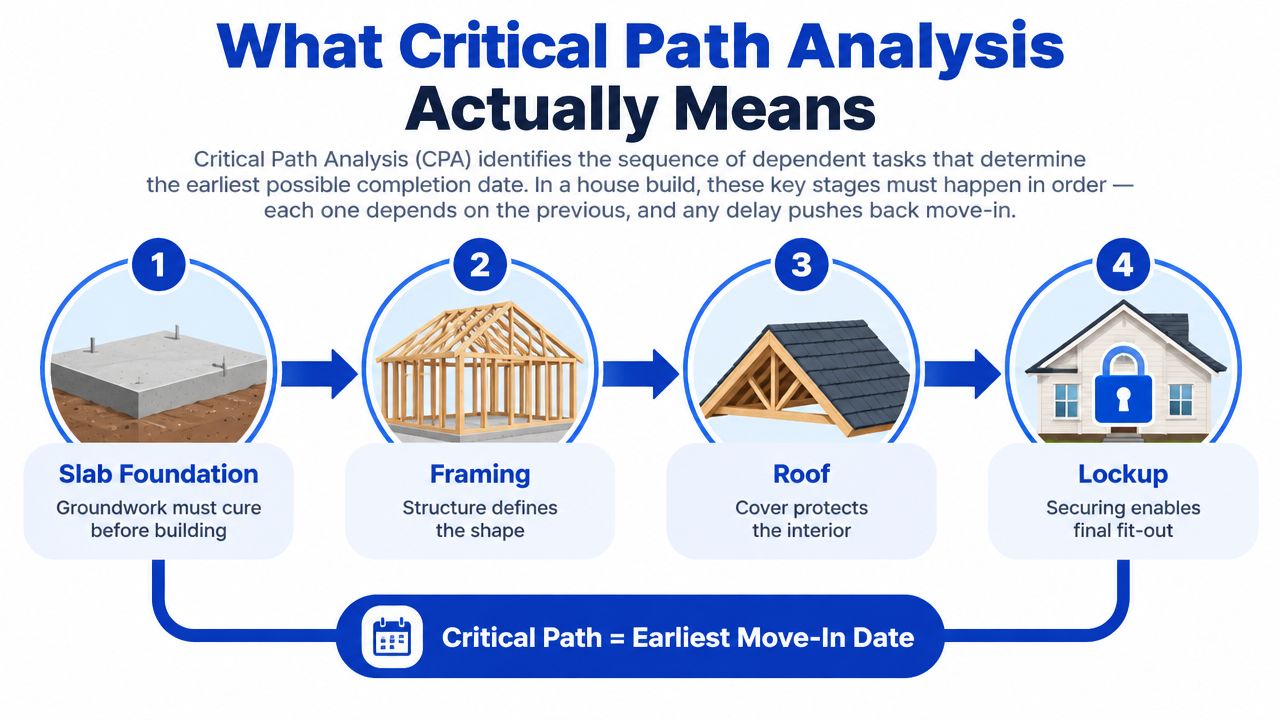
The combined duration of that sequence sets the earliest move-in date. If framing starts late because the slab isn't ready, the roof can't start on time, even if the roofing crew is available. The delay travels through the dependency chain.
The language planners use
CPA becomes easier once the formal terms are tied to practical questions:
- Activity: A defined piece of work, such as preparing a slab or installing a roof.
- Precedence: The relationship that says which activity must happen first.
- Duration: The planned time required to complete an activity.
- Earliest start, or ES: The earliest point an activity can begin based on its predecessors.
- Earliest finish, or EF: The earliest point it can finish, based on its earliest start and duration.
- Latest start, or LS: The latest point it can begin without delaying the project finish.
- Latest finish, or LF: The latest point it can finish without delaying the project finish.
- Float or slack: The time an activity can move without affecting the completion date.
The critical path is the longest sequence of dependent activities through the network. It sounds counterintuitive, because the longest path identifies the shortest possible project duration. The explanation is that every path must be respected, and the longest one is the path that takes the most time to complete.
An activity on the critical path has no available total float under the current plan. A non-critical activity may have room to move, although that room isn't permission to ignore it. Float can shrink as progress changes, resources become constrained, or a new dependency enters the schedule.
CPA therefore works in two ways. It calculates dates through a network, and it gives the planner a management lens for sequencing dependent work. The chart answers what can happen when. The path analysis answers which sequence controls delivery.
Step-by-Step Calculation on a Small Project
Use a small office fit-out to see the method without burying it in notation. The project has seven activities. Some work follows the main construction chain, while electrical and furniture activities can proceed in parallel once the relevant areas are ready.
| Activity | Predecessor | Duration (days) | ES | EF | LS | LF | Float | Critical? |
|---|---|---|---|---|---|---|---|---|
| A. Confirm layout | None | 2 | 0 | 2 | 0 | 2 | 0 | Yes |
| B. Order materials | A | 3 | 2 | 5 | 3 | 6 | 1 | No |
| C. Complete fit-out | A | 6 | 2 | 8 | 2 | 8 | 0 | Yes |
| D. Install electrical systems | A | 4 | 2 | 6 | 4 | 8 | 2 | No |
| E. Complete compliance inspection | C, D | 2 | 8 | 10 | 8 | 10 | 0 | Yes |
| F. Install furniture | B, C | 3 | 8 | 11 | 8 | 11 | 0 | Yes |
| G. Staff move-in | E, F | 1 | 11 | 12 | 11 | 12 | 0 | Yes |
Run the forward pass
Begin at the project start with ES = 0. For each activity, calculate earliest finish as:
EF = ES + duration
Activity A starts at 0 and finishes at 2. Activities B, C, and D can then start at 2 because each depends directly on A. C finishes at 8, D finishes at 6, and B finishes at 5.
Activity E depends on both C and D. Its earliest start must wait for the later predecessor, so ES equals the maximum predecessor EF. E starts at 8 and finishes at 10. Activity F depends on B and C, so it also starts at 8 and finishes at 11. G must wait for both E and F, giving the project an earliest finish of 12 days.
Run the backward pass
The backward pass starts at the project finish. Set G's latest finish to 12, then calculate:
LS = LF minus duration
Move backwards through each predecessor. For activities with several successors, use the minimum successor LS, because the activity must satisfy the tightest downstream requirement.
Finally, calculate float:
Float = LS minus ES
Activities with zero float are critical in this example. The critical path is:
A → C → F → G
Its duration is 12 days, matching the calculated project length. Activity B has one day of float, and D has two days, so those activities can move within that allowance without changing the planned finish, provided their assumptions remain valid.
A planner uses this table in a weekly review by asking three questions:
- Are the critical activities progressing as planned?
- Is float on the other paths being consumed?
- Has a new constraint changed the predecessor logic?
The arithmetic matters, but the decision value comes from reading the table as a priority map.
Drawing the Network and Choosing CPM or PERT
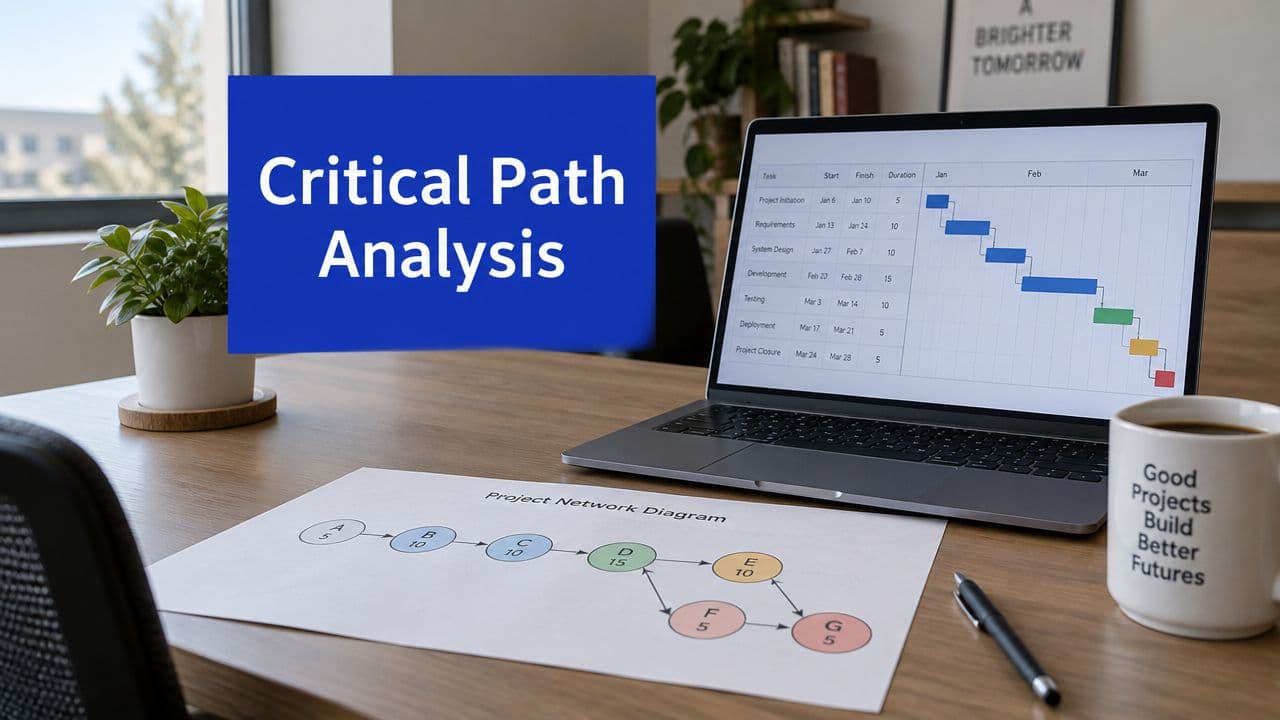
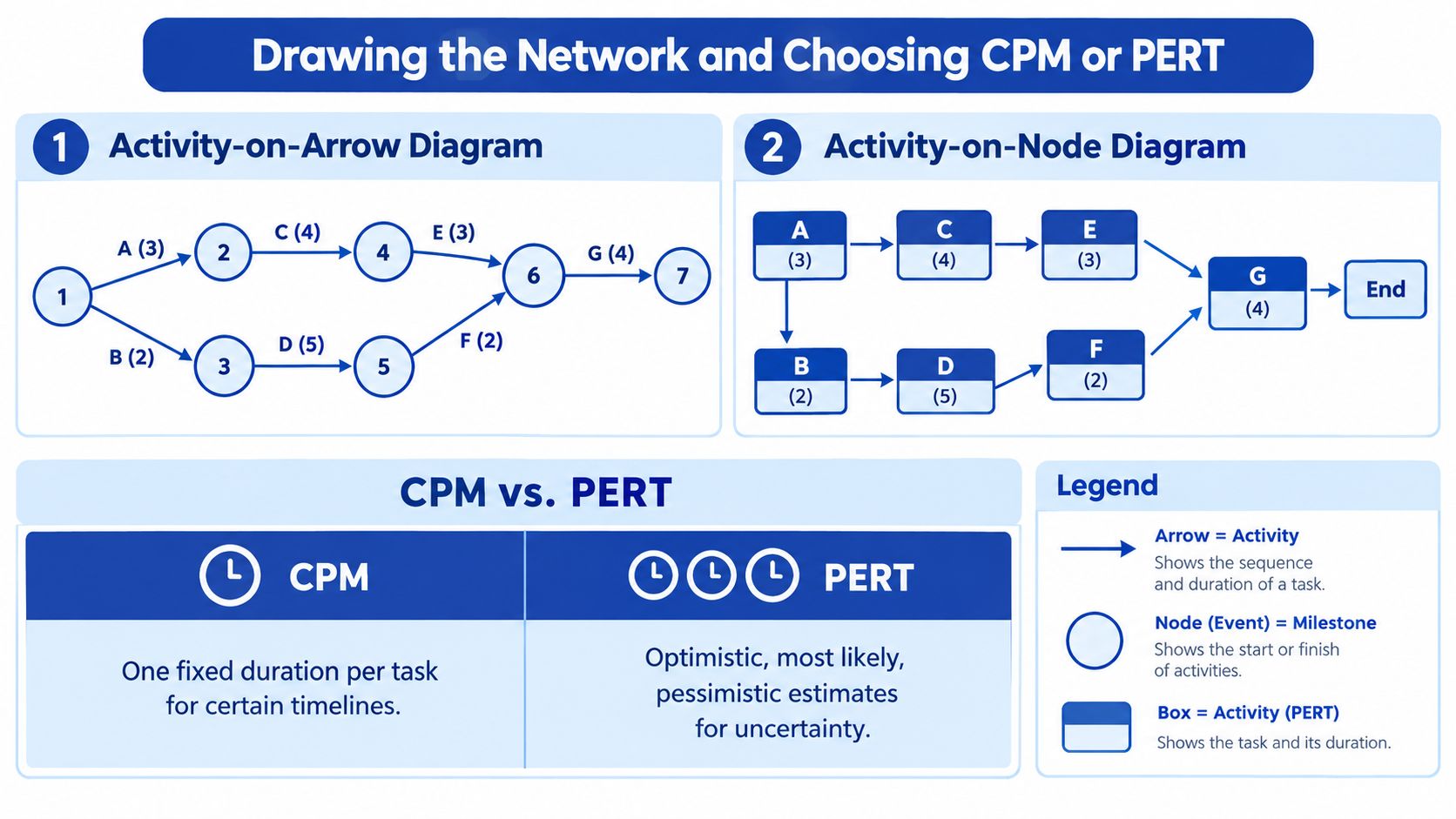
The table becomes easier to challenge when you draw it. A network diagram makes missing predecessors, unnecessary constraints, and convergence points visible before they become schedule problems.
Two ways to represent the same logic
In an Activity-on-Arrow, or AOA, diagram, arrows represent activities and circles represent events or milestones. The arrow from one event to another carries the activity name and duration. AOA diagrams may require dummy activities, which show a logical relationship but consume no work time. They help distinguish paths when several activities share start and finish events.
In an Activity-on-Node, or AON, diagram, each box represents an activity and arrows show the dependency. The duration sits inside the activity node. AON is often easier for modern planners because the task itself carries the information, while the arrows explain the relationship.
Use milestone nodes for events such as “consent issued”, “services connected”, or “ready for inspection”. Add lag notation when a successor must wait after a predecessor finishes, such as a curing period or a scheduled review window. Don't add a dependency merely because two tasks appear in the same work package. It should represent a genuine sequencing requirement.
CPM for known durations
Critical Path Method, or CPM, uses one planned duration for each activity. It's suitable when the work is familiar, the method is defined, and the estimate is stable enough to support a deterministic schedule. A planned fit-out activity, a standard maintenance task, or a repeatable installation may fit this model.
PERT, or Programme Evaluation and Review Technique, is more useful when duration uncertainty is material. It uses optimistic, most likely, and pessimistic estimates rather than one fixed number. A consent review, a complex concrete pour affected by site conditions, or an unfamiliar design development phase may need that wider view.
CPM gives a clear control schedule. PERT gives a more realistic way to discuss uncertainty during early planning. In a regulatory-heavy New Zealand project, a planner may use PERT while approval timing is uncertain, then move towards CPM as the process and evidence become better defined.
Critical Path Analysis Compared to Other Scheduling Methods
CPA isn't a replacement for every scheduling view. It sits underneath several common planning approaches, providing the dependency logic that helps teams decide how a calendar should behave.
| Method | Best For | Key Strength | Key Weakness |
|---|---|---|---|
| Critical path analysis | Projects with defined activities and dependencies | Identifies the sequence controlling completion | Depends on sound logic and duration estimates |
| Gantt chart | Communicating planned work across a calendar | Easy to read and discuss with stakeholders | Can hide the logic behind the bars |
| Critical Chain Project Management | Projects where shared resources constrain delivery | Adds resource considerations and buffers | Requires disciplined resource and buffer management |
| Agile sprints and Scrum | Work where scope is discovered iteratively | Supports short feedback cycles and adaptation | Doesn't naturally replace dependency planning for linear infrastructure work |
A Gantt chart answers, “When is each activity planned?” CPA answers, “Which dependent sequence determines the finish?” A Gantt view is excellent for coordination and reporting, but a row of bars can look healthy even when a predecessor relationship is missing or float has disappeared.
Critical Chain Project Management, or CCPM, builds on path thinking by treating resource availability as a central constraint and using buffers to protect delivery. It suits environments where the same specialist, crew, or piece of plant is required by several competing activities.
Agile sprints take a different approach. Scrum teams organise work into iterative delivery cycles rather than relying on one detailed, fixed network from start to finish. That makes agile useful when requirements are still emerging, but it doesn't remove the need to map dependencies for a consent-driven build, a plant shutdown, or a compliance implementation.
For teams reviewing their wider operating model, process improvement consultancy can help identify where workflow design, handovers, and approval steps are creating avoidable constraints.
A practical decision rule is:
- Use CPA to plan dependency-driven delivery.
- Use Gantt to communicate the plan.
- Use CCPM when resources are the binding constraint.
- Use agile when the scope is still being discovered.
How Real Schedules Behave Under Pressure and Constraints
A textbook network assumes that the required resources will be available when the logic calls for them. Real projects don't work that neatly. Crews are shared, plant arrives late, scope changes enter through variations, and an approval authority may control a date the project team can't directly set.
Consider a New Zealand watermain renewal. The excavation may be straightforward, but the controlling sequence could run through consent conditions, traffic management approval, supplier lead times, site access, installation, pressure testing, and reinstatement. The dig itself may not be the main schedule risk. If the traffic management plan isn't accepted, the crew can't safely access the work area, regardless of labour availability.
Constraints can create a new path
Adding people or plant doesn't automatically shorten a critical activity. If a predecessor hasn't released the workfront, if a curing period must pass, or if one qualified operator is already committed elsewhere, additional capacity may sit idle. The planner must distinguish between a logic constraint, a resource constraint, and a calendar constraint.
Scope change creates another problem. A new inspection, design review, or commissioning requirement can consume the float on a previously comfortable path. That path may then become critical, while the original critical path gains flexibility after a recovery action.
New Zealand research into construction and land development identifies review and approval delays, lengthy consent processes, late regulatory responses, poor coordination within authorities, poor planning and scheduling, design errors, and slow design development among major delay drivers (New Zealand research on construction delay drivers). Those findings reinforce a practical point: the network must include regulatory interfaces, not just physical work.
Procurement also belongs in the schedule logic. Teams managing specialist materials and supplier exposure can use guidance on resilient sourcing decisions alongside their schedule review, especially where a lead time could hold a critical installation.
A project controls lead should be able to answer:
- Where will the project slip first if today's risk occurs?
- Which approval or handover has the least recovery room?
- Which resource constraint could create a second critical path?
- Which float or management allowance can absorb the disruption?
The answers change as the project changes, so the analysis must be refreshed rather than treated as a one-off planning exercise.
Pitfalls to Avoid and KPIs That Prove the Schedule Works
Most schedule failures don't arrive with a dramatic warning. A planner identifies the path during mobilisation, stops recalculating it, and keeps reporting against a plan that no longer reflects the work. Meanwhile, non-critical float erodes until a supposedly flexible activity becomes the next bottleneck.
Common traps include:
- Freezing the first critical path: The path can change when durations, dependencies, resources, or scope change.
- Ignoring float erosion: A task with available float still needs monitoring when that allowance is being consumed.
- Updating only the Gantt bars: Changing a duration without rerunning the network can leave ES, EF, LS, LF, and float values inconsistent.
- Leaving resources outside the logic: A schedule may show parallel work that the available crew can't perform simultaneously.
- Skipping the baseline: Without a controlled baseline, the team can't distinguish approved change from poor execution.
| Common Pitfall | Exposing KPI | Healthy Target |
|---|---|---|
| Critical path not refreshed | Critical path length variance | Agreed project-specific tolerance |
| Float disappears unnoticed | Float burn-down | Stable float on near-critical paths |
| Weak dependency logic | Activities with defined predecessors | Complete coverage for logic-driven work |
| Resource conflicts override the plan | Constraints overriding logic | Reviewed and actively resolved |
| Progress isn't tied to value | SPI and CPI | Agreed control thresholds |
Schedule Performance Index, or SPI, and Cost Performance Index, or CPI, can support earned-value reviews when the project has the required cost and progress data. Critical path length variance shows whether the controlling sequence is extending, while float burn-down highlights risk before the final date moves.
The target shouldn't be copied from another project. Set it during controls planning, document the tolerance, and review exceptions with the delivery team. A healthy schedule isn't one with no movement. It's one where movement is visible, explained, approved where necessary, and connected to the current network logic.
For teams using monday.com, monday.com integrations for connected project workflows can help bring schedule, progress, and operational information into a more connected review process.
Implementing and Automating CPA with the Right Partner
Software doesn't create a reliable critical path by itself. A platform can calculate dates quickly, but it can't decide whether “consent issued” precedes mobilisation, whether two activities can run in parallel, or whether a supplier promise is credible.
A practical monday.com implementation starts with a clean activity structure. Create items for the work, add duration and date columns, define dependency relationships, identify milestones, and record the owner responsible for each handover. The board can then support automations that notify owners when predecessors move, flag overdue critical work, and surface tasks whose float is being consumed.
Keep judgement in the control loop
The planner still needs to validate the network with subject-matter experts. Construction supervisors, consenting specialists, procurement leads, operations managers, and finance stakeholders may each hold part of the sequencing logic. The board should also connect schedule outputs with resource registers, risk actions, change control, and evidence required for delay assessment.
Teams exploring digital scheduling can review how platforms help master project timing with critical path, while implementation work should focus on the operating rules that keep the data current. Wisely can configure monday.com boards, support workflow design, train planners to interpret float and schedule indicators, and establish a recurring governance cadence. Its monday.com implementation service is relevant where the organisation needs the workflow designed around its actual delivery process rather than copied from a template.
A sensible starting point is a two-week pilot on one live project. Build the network end to end, validate the dependencies with the people doing the work, compare the calculated path with the team's practical view, and run the weekly review inside the platform. Scale only after the team can explain why the path changed and who owns the response.
Wisely helps project and operations teams design monday.com workflows that connect dependencies, approvals, resources, risks, and progress into a practical critical path control. Visit Wisely to discuss a focused two-week pilot for one live project and turn schedule analysis into a weekly operating discipline.