
You've just approved a dividend, opened the statement, and found a line labelled imputation credits. It may sit beside the cash dividend, but it doesn't look like cash in your bank account. So what is it, where did it come from, and why should you care before making the next distribution?
The short answer is that an imputation credit records company tax already paid. Used correctly, it can stop you or your shareholders from paying tax twice on the same business profit. The longer answer matters for growing New Zealand SMEs, particularly when R&D claims, tax losses, provisional tax, and dividend timing start affecting the company's numbers.
The Basics of Imputation Credits for Business Owners
Your company has finished the year with profit, and you are considering a dividend. The accounts show retained earnings, cash is available, and the dividend statement includes imputation credits. Before approving the payment, you need to understand what that credit represents and how it affects the tax outcome for you and other shareholders.
Company profit usually encounters tax before any dividend reaches a shareholder. The company pays income tax on its taxable profit, then may distribute some of the remaining amount. New Zealand's imputation system connects those two events by allowing the company to attach a record of tax already paid to the dividend. The shareholder declares the cash dividend and attached credit together, then applies the credit against their own tax payable. Inland Revenue describes this approach in its guidance on the New Zealand imputation system.

A tax-paid receipt, not extra cash
An imputation credit is evidence that the company has already paid New Zealand income tax connected with the profit being distributed. It records tax history and gives the shareholder recognition for that payment through the dividend statement.
The statement separates the distribution into connected pieces:
- Cash dividend: The amount paid into the shareholder's account.
- Imputation credit: The company tax attached to that distribution.
- Assessable income: The cash dividend and credit considered together for tax purposes.
- Tax offset: The credit applied against the shareholder's resulting tax bill.
This explains why the credit shown on a dividend statement may exceed the shareholder's personal tax payable on the distribution. The shareholder includes the full amount for tax purposes, while the credit recognises company tax already paid on the underlying profit. The result depends on the shareholder's own tax position, so the credit does not automatically mean the same cash saving for every recipient.
Australian business owners may recognise a related concept under another name. This explanation of tax credits on dividends in Australia offers context for comparison, although Australian rules should not be applied automatically to a New Zealand company or shareholder.
Where the credits come from
Credits arise from income tax paid by the company and are tracked in its tax records and imputation credit account, often called the ICA. The ICA records credits entering the company's available pool and debits created when credits are attached to dividends. Its balance therefore needs checking before a distribution is approved.
Growing SMEs should also connect this review to R&D activity. An R&D claim or tax loss can reduce the company's current tax payable. That may affect the credits available for later dividends, even where the business has retained earnings and enough cash to make a distribution. Profit, cash, tax paid, and the ICA are separate pieces of the decision.
The 28:72 imputation ratio determines how much credit can accompany a fully imputed dividend. Understanding that relationship helps owners avoid treating retained profits as though they automatically carry matching tax credits.
Practical rule: Before approving a dividend, review available cash, retained earnings, the shareholder tax position, tax paid, and the imputation credit balance separately.
New Zealand has used this framework since 1988. For business owners, the value lies in matching company tax payments with well-timed, properly documented dividends, particularly as R&D claims and changing profit levels affect the company's credit position.
Decoding the 28 - 72 Ratio and Imputation Credit Accounts
A growing New Zealand SME may have strong retained profits, enough cash for a shareholder dividend, and still lack enough imputation credits to fully impute it. The 28:72 ratio and the company's Imputation Credit Account, or ICA, explain why those figures must be reviewed separately.
The maximum imputation ratio is 28:72. In practical terms, a company can attach up to 28 cents of imputation credit for each $1 of gross dividend, while 72 cents is the cash dividend paid to the shareholder. Inland Revenue explains the limit and its connection to the company tax rate in its guidance on the maximum imputation ratio.
Why the ratio is capped
The cap mirrors the 28% company tax rate the company has paid, so no additional tax value can be attached beyond that amount. The ratio connects tax already paid by the company with the dividend later received by the shareholder.
A fully imputed $1 gross dividend has three parts:
- 72 cents of cash dividend paid to the shareholder.
- 28 cents of imputation credit attached to that cash payment.
- $1 of grossed-up dividend income used for the shareholder's tax calculation.
The gross amount is the figure used for tax, which can make the ratio seem counterintuitive at first. The company does not pay $1.28 in cash. It pays 72 cents and records a 28-cent credit alongside it, creating $1 of grossed-up income for tax purposes.
Inland Revenue also expresses the equivalent credit value as 38.89 cents for each $1 of net profit after tax. That view helps an owner work backwards from after-tax company profit when considering how much grossed-up dividend the business may be able to support. The result still depends on the company's actual credit balance and the distribution rules.
The ICA is the company's credit ledger
The Imputation Credit Account, or ICA, records tax paid by the company and credits attached to shareholder distributions. It shows the movements that determine how much credit remains available for future dividends. Inland Revenue's guidance on how imputation credit accounts work provides the technical reference for your accountant or finance team.
Treat the ICA as a controlled ledger:
- Company tax paid can increase the available credit balance.
- Credits attached to dividends reduce that balance.
- Other tax adjustments can create entries that need recording.
- The closing balance helps determine whether a proposed dividend can be fully imputed.
An R&D claim or tax loss can reduce current company tax payable. That may leave fewer credits available for a later dividend, even when retained earnings and cash appear sufficient. Dividend planning should therefore bring together the financial statements, tax position, R&D activity, cash forecast, and ICA balance. Accounting support for financial services may help connect accounting records with tax reporting.
A useful founder habit is to review the ICA before approving a dividend, rather than discovering its balance after the declaration. The dividend paperwork, ICA movements, tax return, and shareholder reporting should agree. Your accountant should confirm the available credits and permitted ratio before directors approve the distribution.
How Credits Actually Save You Cash at Tax Time
A founder approves a dividend, sees cash leave the company, and then faces a personal tax bill. The result feels confusing until the dividend is separated into two parts: cash paid to the shareholder and company tax already represented by an imputation credit.
Start with a $1 gross dividend that is fully imputed at the maximum ratio. The shareholder receives 72 cents in cash and 28 cents of imputation credit. For tax purposes, the dividend is still $1 of grossed-up income. The attached credit is then used against the tax calculated on that full amount.
At the 33% resident withholding tax rate, tax on the $1 gross dividend is 33 cents. The 28-cent credit covers most of that liability, leaving a 5-cent difference to be handled through withholding or the shareholder's final tax position. Inland Revenue's resident withholding tax guidance for dividends explains how resident withholding tax applies to the gross amount and how attached credits account for the difference between the 28% company rate and the 33% dividend tax rate.
Dividend Tax Impact Comparison
| Dividend Type | Gross Dividend | Imputation Credit | Tax Payable by Shareholder | Net Cash Retained |
|---|---|---|---|---|
| Fully imputed | $1 | 28 cents | 5 cents after the credit | 67 cents |
| Unimputed | $1 | 0 cents | 33 cents | 67 cents |
The comparison shows what the credit does. At the same 33% personal tax rate, both examples can leave the shareholder with the same final cash after tax. The fully imputed dividend does not remove tax. The company has already paid part of it, and the credit stops that same portion from being charged again to the shareholder.
The cash timing is different. A fully imputed dividend delivers 72 cents and leaves a smaller top-up to fund. An unimputed dividend delivers the full $1 initially, but the shareholder must set aside more cash for tax. That distinction can matter to a founder managing personal cash, provisional tax, or the timing of a larger distribution.
The company's imputation credit account, or ICA, sits behind this calculation. It records the credits available to attach to dividends. A proposed distribution can therefore look affordable from the bank account and retained earnings, while the available credits still limit how much of it can be fully imputed. The board needs both the dividend amount and the ICA position before approving the payment.
R&D claims add another timing consideration for growing SMEs. A claim can change the company's tax position and may affect the credits available for a later dividend. The expenditure, tax return, credit movement, and dividend decision may occur at different points, so a forecast based only on the cash balance can mislead. Dividend planning should connect the tax calculation, R&D position, cash forecast, and ICA records.
Resident withholding tax is a collection mechanism, not necessarily the shareholder's final result. The final liability depends on the shareholder's wider income and applicable tax rate. Excess credits may also be subject to rules that affect how their value can be used, so a credit cannot always be treated as cash available on demand.
Before declaring a dividend, ask how much cash the company wants to distribute and how much company tax can be passed through as credits. Tax services for businesses can support the tax planning alongside your accountant's formal advice and compliance work.
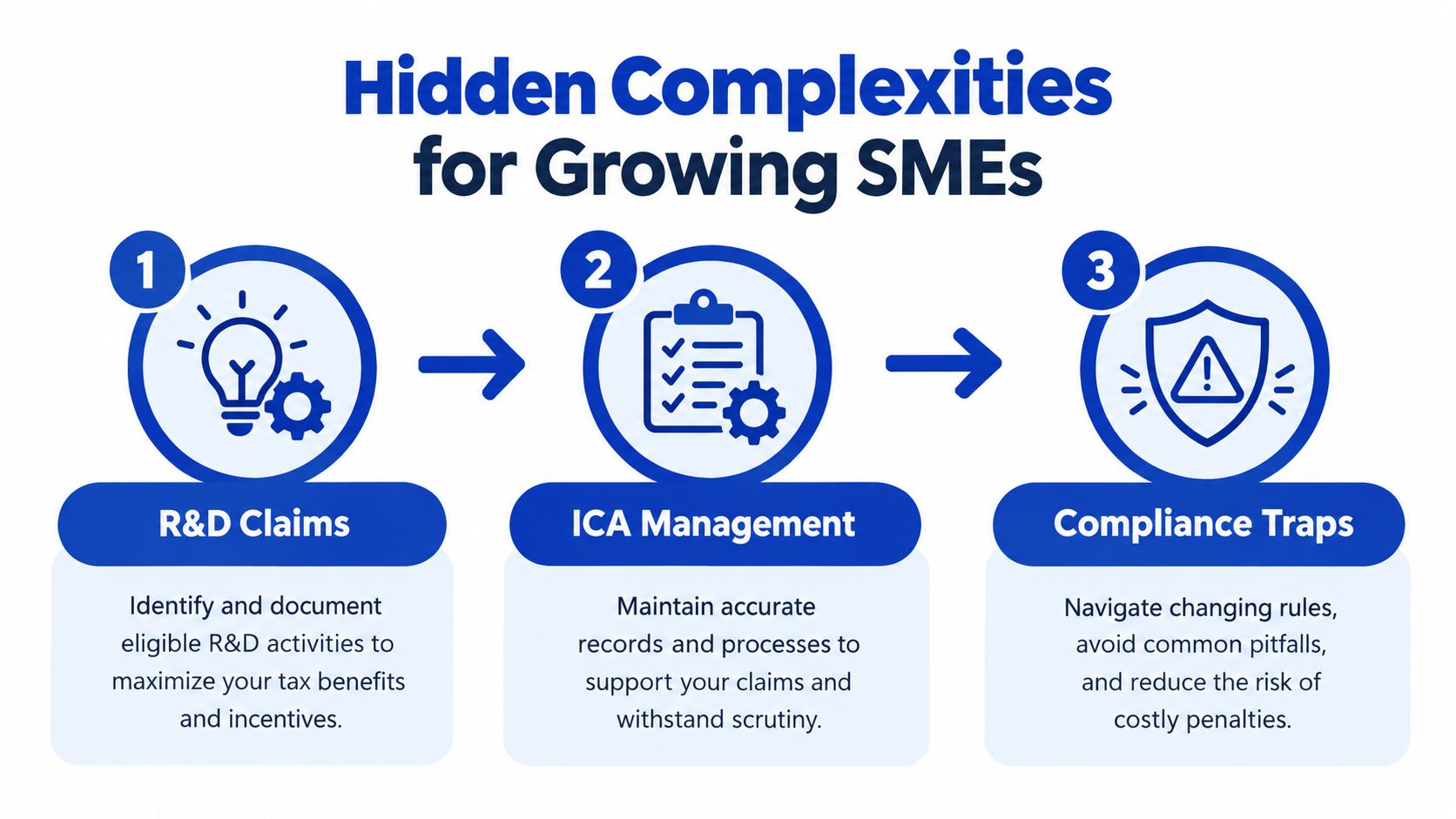
Hidden Complexities for Growing SMEs and R&D Claims
A small company can treat imputation as a straightforward dividend exercise. A growing SME usually can't. The ICA changes as tax is paid, credits are attached, and tax adjustments are processed. The number you saw before filing the annual return may not be the number you need when the return is complete.
R&D claims can move the ledger
R&D-focused companies need to pay particular attention to the interaction between tax credits and the ICA. Inland Revenue's guidance says an R&D tax credit can generate an imputation credit or debit when the income tax return is filed. That means the R&D claim can affect the imputation position at a different point from the original expenditure, tax payment, or dividend decision.
The practical consequence is timing risk. A founder may expect the R&D claim to improve the company's tax position, then discover that the filing creates an ICA movement that needs to be reconciled. The business may have planned a dividend using an earlier estimate, while the final tax return produces a different credit position.
Losses and unused credits need attention
Annual imputation return guidance also connects unused imputation credits with tax loss carry-forward calculations. For an SME carrying losses while continuing to invest in product development, hiring, or market expansion, that interaction deserves a deliberate review.
- R&D claims: Confirm whether the filing creates an imputation credit or debit and when the movement enters the ICA.
- Tax losses: Ask how unused credits interact with the company's loss carry-forward position.
- Dividend timing: Compare the proposed declaration date with tax payment and return-filing dates.
- Group structures: Check which company has paid the tax and which company intends to distribute the dividend.
A credit balance can look healthy and still be unavailable for the dividend you want to declare if the underlying entries haven't been completed or reconciled.
This is why imputation isn't a set-and-forget benefit. A bookkeeper may record the dividend correctly, but the finance team still needs to connect the dividend resolution, shareholder statements, income tax return, R&D claim, and ICA records. As the company scales, a monthly or quarterly review can expose timing differences before they become an unpleasant year-end surprise.
Strategic Planning and the Virtual CFO Advantage
New Zealand's imputation framework has been in place since 1988, which gives founders a long-established system to work with rather than a temporary incentive. The strategic opportunity comes from treating the ICA as part of the company's capital planning, not as a line item that appears after the accounts are closed.

A Virtual CFO can bring the tax ledger into the same conversation as cashflow forecasting, debt decisions, reinvestment, and shareholder remuneration. That doesn't mean distributing every available profit. It means comparing the options clearly:
- Keep profit in the company to fund growth.
- Repay debt and strengthen liquidity.
- Declare a dividend when cash and credit capacity support it.
- Adjust shareholder remuneration so personal tax and company cashflow are considered together.
The timing matters because company tax payments and dividend declarations don't always happen together. A forecast that shows cash available for distribution may not show enough available imputation credits. Conversely, a company may accumulate credits while founders delay distributions, leaving the finance team to consider how and when those credits can be used within the rules.
A Virtual CFO can also build a forward view that combines expected taxable profit, tax payments, R&D adjustments, loss carry-forwards, dividend proposals, and shareholder outcomes. That gives directors a better basis for deciding whether to distribute profit now or retain it for the next stage of growth. For businesses preparing for lenders or investors, guidance on cash flow and fundraising prep can complement that broader planning process.
Here's a short visual prompt for thinking about the wider role of financial leadership:
A specialist financial partner can help turn the ICA into a decision-support tool rather than a compliance afterthought. Services such as Virtual CFO support can help a growing business connect forecasting, budgeting, tax planning, cashflow, and capital decisions. The value is in making the trade-offs visible before directors commit the company to a dividend or a major reinvestment programme.
Your Imputation Credit Health Checklist
A dividend can look affordable in the accounts while the company's ICA cannot support the attached credits. Use this checklist before approving a distribution or finalising the annual tax position. It will not replace professional advice, but it can reveal missing information before the paperwork is issued.
Before declaring a dividend
- Check the ICA balance: Confirm the available credit balance separately from retained earnings. Retained profit does not automatically mean matching imputation credits are available.
- Review the ratio: Test the proposed attachment against the 28:72 maximum imputation ratio described in Inland Revenue guidance.
- Match the paperwork: Make sure the board or director resolution, dividend statement, accounting entry, and tax records describe one consistent distribution.
- Model shareholder cash: Show the cash dividend, attached credit, withholding amount, and expected tax top-up as separate figures.
Before filing the annual return
- Review R&D movements: Confirm whether the R&D claim changes the company's tax result and whether that creates an imputation credit or debit when the income tax return is filed.
- Check loss carry-forwards: Establish how unused credits sit alongside tax losses carried forward, and whether either affects the proposed distribution.
- Reconcile tax paid: Match company tax payments and other relevant entries to the ICA records.
- Ask about excess credits: Confirm how any excess could affect future tax positions and whether further planning is required.
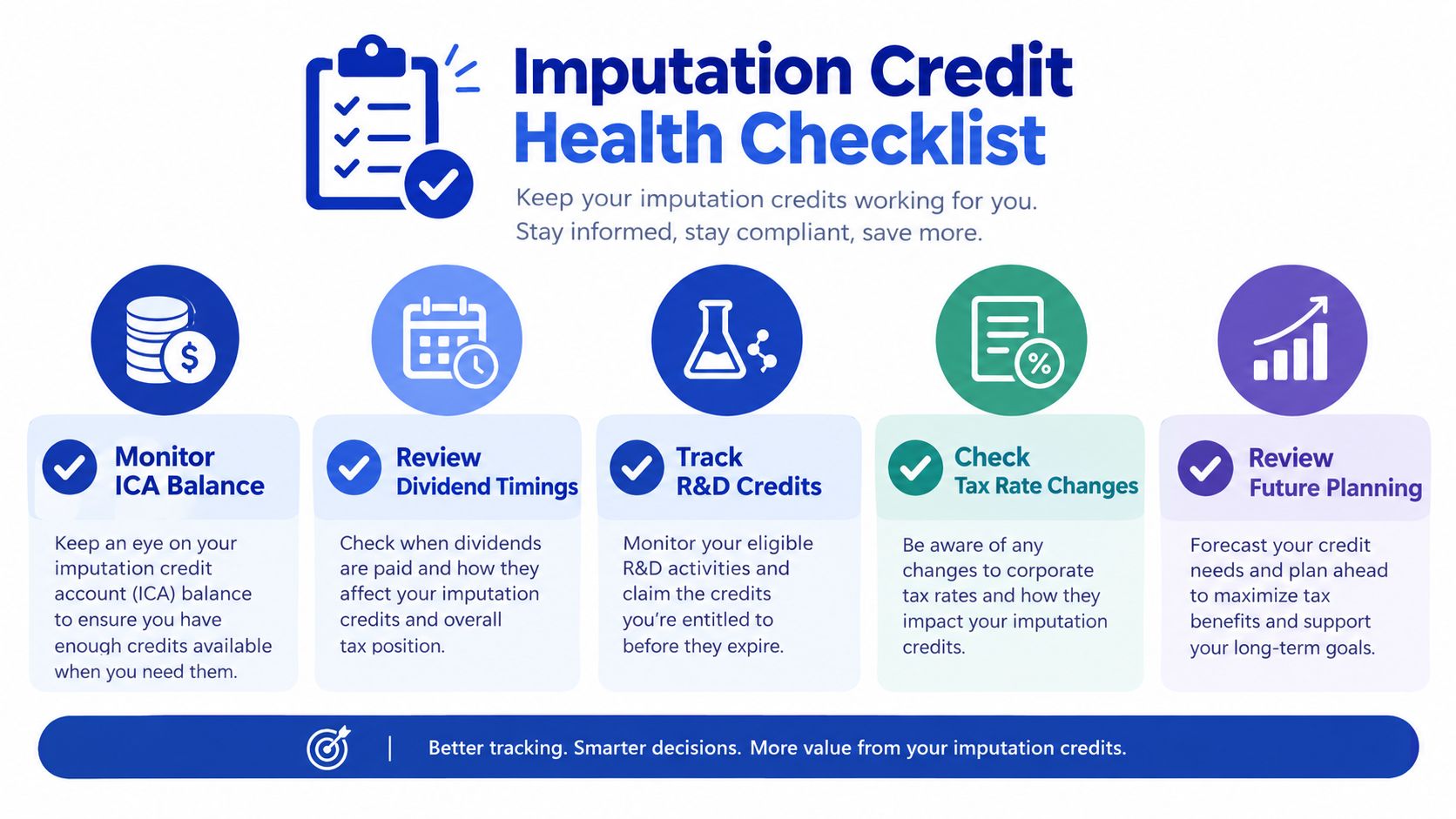
Review the ICA before the dividend decision, while the company can still change the amount or timing. Ask your accountant or finance adviser to show the effect on company cash, shareholder withholding, R&D adjustments, and carried-forward tax positions.
Wisely connects accounting, tax planning, cashflow forecasting, and Virtual CFO support. Visit Wisely to discuss dividend decisions and tax information with greater clarity.