Your sales manager wants cleaner pipeline visibility. Operations wants every sold deal handed over properly. Finance wants fewer surprises at invoicing time. Meanwhile, the team is still updating spreadsheets, forwarding email threads, and asking who owns the next step.
That's the decision behind monday CRM vs HubSpot for a 10 to 50 person team. You aren't just buying contact management. You're choosing how much process change your people can absorb, whether sales data should sit inside a broader operating system, and how much administration you're prepared to fund.
For most New Zealand teams in this size range, I recommend monday CRM when sales must connect closely with delivery and operations. I recommend HubSpot when marketing is already a serious, dedicated revenue function. The wrong choice isn't the platform with fewer features. It's the platform your team won't use consistently.
Why CRM Adoption Fails in Growing NZ Teams
A growing New Zealand business can have capable staff and loyal customers while still relying on spreadsheets, email threads, and informal handoffs. The 2025 CPA Australia New Zealand market summary reports that 32.4% of NZ small businesses generated more than 10% of revenue from online sales, while 35.4% received more than 10% of sales through digital payment options. Only 18.4% sought advice from IT consultants or specialists, and NZ businesses ranked lowest among surveyed markets on nearly all technology-adoption indicators.
For a 10 to 50 person team, CRM adoption therefore starts with operating discipline. The business may lack clear data ownership, documented handoffs, or a person responsible for administration. A powerful system can add daily work when it introduces more fields, alerts, and reporting obligations without removing existing spreadsheets and conversations.
CRM experience is also limited across the market. One NZ-focused summary cites research indicating that only about 15% of New Zealand businesses use a CRM at all (NZ CRM adoption summary). The same summary reports that just 2% of business websites use CRM technology, with urban firms 2.4 times more likely to adopt CRM than rural counterparts. Many teams are implementing their first repeatable sales process rather than replacing an established platform.
Adoption is a management problem
A CRM fails when salespeople treat it as management reporting, delivery staff see it as a sales database, and leaders leave “updated” undefined. Technical configuration cannot produce reliable forecasts if stages fail to reflect buying decisions or staff skip activity logging.
Set a small number of behaviours and enforce them:
- Every opportunity has an owner: The next action must have a named person.
- Each stage has an exit rule: A deal advances after a defined business event.
- Every open deal has a next step: Pipeline visibility depends on recorded action, not a label alone.
- Leaders use the data: Weekly decisions should rely on the CRM, or staff will conclude that data quality does not matter.
Teams formalising these rules should review pipeline metrics and fixes before building dashboards. Let the measurement model follow the sales process rather than the other way around.
Choose the lower-friction first move
HubSpot suits a business prepared to coordinate sales, marketing, and service through a broader customer platform. That structure brings more decisions about lifecycle stages, ownership, automation, and reporting. monday CRM fits teams that need sales activity connected to delivery, operations, and internal requests through a visual work environment.
For a non-sales team, that shared workflow can reduce the change-management burden. Sales, operations, and delivery can work from related boards instead of treating the CRM as a specialist sales system. This supports the cross-functional reality of a growing NZ business, where one person may manage several parts of the customer journey.
Implementation support still matters. Role-based monday.com training helps staff learn the agreed workflow, including ownership and update rules, rather than just locating features. For a business without a dedicated CRM owner, that distinction affects adoption and total cost of ownership.
Practical rule: Choose the platform your least enthusiastic user can update correctly on a busy day.
Comparing Core Philosophies and Workflow Automation
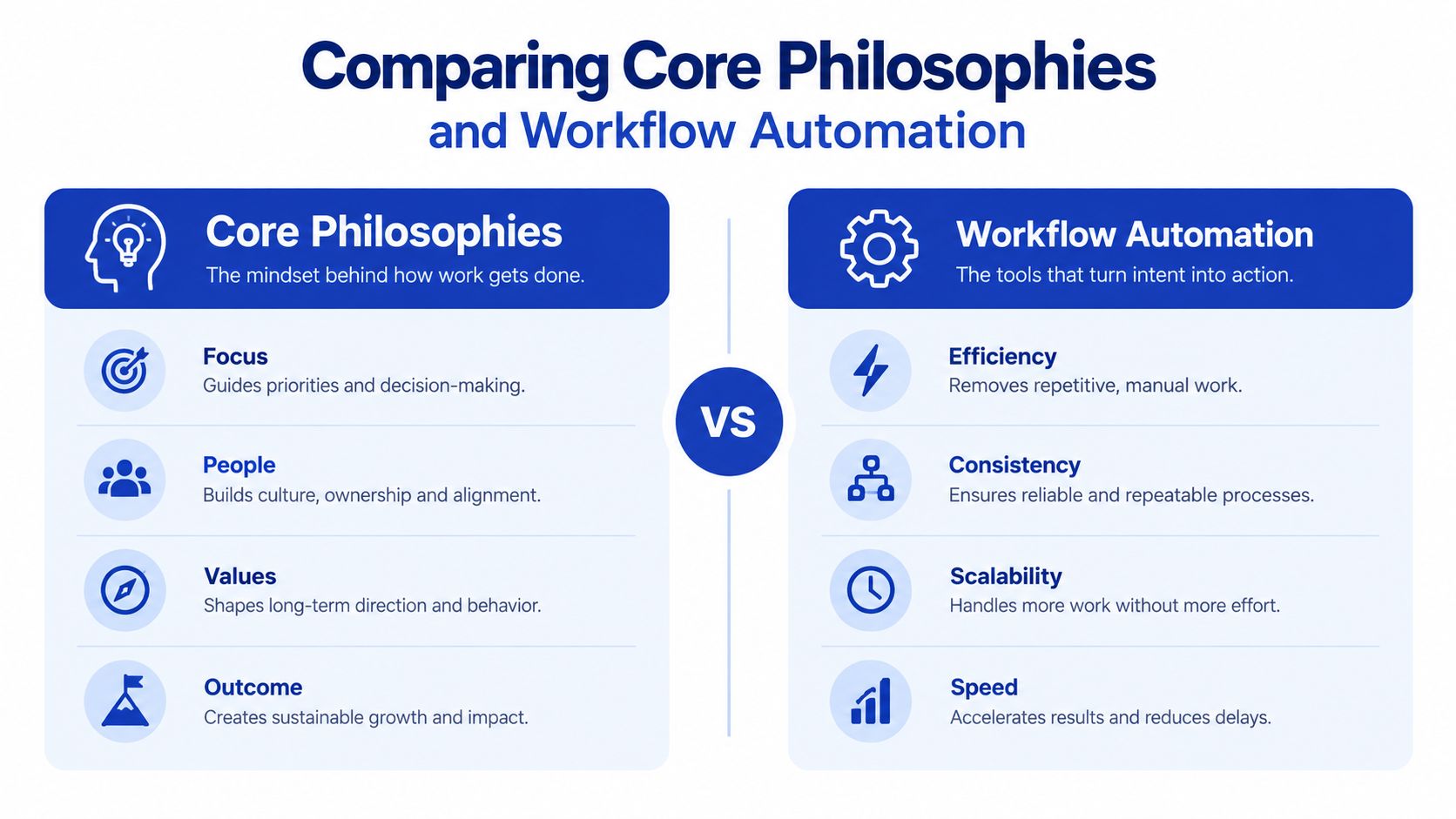
Workflow automation software connects a business event to a defined action. A deal entering a new stage might create a task, notify an account manager, update a project record, or request information from finance. The value comes from removing repetitive coordination, not from accumulating a long list of automations.
HubSpot starts with a customer platform philosophy. Its centre of gravity is the contact and company record, with sales, marketing, and service activities organised around the customer lifecycle. That structure is powerful when marketing generates demand, sales qualifies it, and service continues the relationship inside a deliberately designed revenue operation.
monday CRM starts with a work operating system philosophy. Sales records live in a visual, configurable environment that can also contain project boards, delivery tasks, internal requests, and operational workflows. The important advantage for a cross-functional team is continuity. The process after the sale can use the same visual language as the process before it.
Where HubSpot earns its complexity
HubSpot is stronger when you need deep alignment between marketing activity and sales execution. A marketing-led organisation may want campaign context, lead nurturing, sales sequences, service history, and reporting in a connected customer record. In that environment, the extra structure isn't administrative decoration. It supports a defined go-to-market model.
The trade-off is that the team must own more configuration. Someone needs to decide which properties matter, which lifecycle rules apply, how records are governed, and when automation should run. Without that ownership, HubSpot can become a large repository of partially used features.
HubSpot is therefore a good fit for:
- Marketing-led acquisition: Content, campaigns, forms, and nurture activity materially influence pipeline.
- Dedicated operations ownership: Someone can maintain properties, workflows, permissions, and reporting.
- Customer lifecycle depth: Sales and service need a single, structured history.
Where monday CRM wins
monday CRM is better suited to businesses whose sales process is inseparable from delivery. A construction firm, agency, professional services company, or production studio may need to connect opportunity stages with estimating, resource planning, onboarding, approvals, and project execution.
Its visual boards and configurable automations let the team model those handoffs without forcing every department into a marketing-first structure. The approach is documented in monday CRM workflow guidance, where the practical focus is on building a usable sales process inside a broader work environment.
The decision is straightforward:
| Operating reality | Better starting point |
|---|---|
| Marketing owns a structured demand-generation engine | HubSpot |
| Sales needs a strong connection to delivery | monday CRM |
| Service history must sit beside marketing and sales data | HubSpot |
| Projects and operational work already run in monday.com | monday CRM |
| The team needs flexible, visual workflows | monday CRM |
| The business can support dedicated CRM administration | HubSpot |
My view is blunt. If your main problem is marketing and sales alignment, choose HubSpot. If your main problem is sales-to-operations coordination, choose monday CRM.
Pricing Structures and Total Cost of Ownership
Headline pricing can produce a poor decision because the licence is only one part of the bill. A 10 to 50 person NZ team should evaluate seat rules, which capabilities sit behind each tier, implementation effort, training, data cleanup, integrations, and the internal time required to keep the system accurate.
Independent NZ directory data lists monday CRM Basic at NZD $18 per seat per month with a minimum of 3 seats, while HubSpot Sales Hub has a free tier and paid Starter plans from NZD $25 per month (NZ CRM pricing comparison). Treat these as published directory figures, not a permanent quote. Vendors change packaging, billing terms, taxes, and included features.
The cost factors that change the decision
| Cost Factor | HubSpot Sales Hub | monday CRM |
|---|---|---|
| Entry route | Free tier available, paid Starter from NZD $25 per month in NZ directory listings | Basic from NZD $18 per seat per month in NZ directory listings |
| Seat constraint | Entry pricing can suit a small pilot | Basic has a minimum of 3 seats |
| Expansion pattern | Costs can rise as the team adds deeper sales, marketing, or service capabilities | Costs are easier to assess when the team primarily needs workflow and work management |
| Implementation | More process design may be required where marketing, sales, and service are connected | Board and automation design may require more configuration for unusual sales processes |
| Training | Users may need role-specific training across a broader platform | Users need clear conventions for boards, columns, ownership, and automations |
| Ongoing administration | Property governance, permissions, workflows, and reporting need an owner | Board structure, automation maintenance, permissions, and connected workflows need an owner |
| Integration cost | Additional hubs or connectors may influence total spend | Connecting finance, delivery, or specialist tools may require integration design |
HubSpot is often the lower-risk option for a very small pilot because a free tier reduces the initial commitment. monday CRM can become more cost-efficient when three or more users are active and the team also needs project-style workflows. Neither statement answers the 12-month question on its own.
Price the internal work honestly
Implementation takes time even when the software is easy to configure. Someone must clean duplicate contacts, define fields, agree pipeline stages, connect email and calendar tools, test automations, prepare training, and monitor adoption. If your team is already stretched, internal hours are a real cost.
The same principle applies to wider technology support. A useful managed IT services pricing guide can help founders think about support as an operating cost rather than an emergency expense. CRM ownership belongs in that conversation, especially when integrations touch finance, identity, security, or client data.
Use this budget test:
- Price the active users: Include everyone who must update or consume the workflow, not only sales staff.
- List the required capabilities: Separate must-have sales functions from future marketing or service ambitions.
- Estimate setup ownership: Assign hours to data preparation, configuration, testing, and training.
- Allow for optimisation: The first version won't fit every exception.
- Model expansion: Ask what happens when more departments, hubs, or integrations are added.
The cheapest licence is not necessarily the cheapest system. The lower-risk choice is the one your team can operate without permanent manual workarounds.
Cross-Functional Use Cases Beyond the Sales Pipeline
A deal is not finished when a salesperson marks it closed. The business still needs to schedule delivery, confirm scope, raise invoices, create client access, allocate people, and protect the customer experience. A workflow-first CRM can therefore create more value than a sales database that stops at the contract.

Operations and delivery handoffs
Consider a professional services firm. A salesperson wins an engagement and changes the deal status. That event should create a delivery record with the client, agreed scope, responsible manager, target dates, and outstanding information. The delivery team shouldn't reconstruct the opportunity from email or ask the salesperson to repeat details already captured.
monday CRM is naturally suited to this pattern because the sales board can connect to project and task workflows. The team can keep commercial information visible while giving delivery staff the operational view they need. HubSpot can support structured handoffs too, but the design usually centres on customer records and connected objects rather than a shared work-management environment.
Finance triggers
A closed deal can also initiate a finance workflow. The trigger might request a purchase order, notify the accounts team, create an invoice request, or flag payment terms for review. The CRM shouldn't replace accounting software, but it should make the handoff explicit.
That matters when founders currently rely on memory. A visible status such as “won, awaiting billing details” is more useful than a closed deal that disappears from the sales team's attention.
IT and client onboarding
New clients often need user accounts, access permissions, security checks, or equipment. An onboarding request can be created automatically when a deal reaches the correct stage, with fields for the technical owner, required approvals, and completion status. IT can work from its own queue without losing the commercial context.
This model also suits media and post-production studios. A sold project may require secure asset transfer, access controls, review approvals, and documented handoffs aligned with TPN requirements. A shared workflow lets sales, production, and technical teams see dependencies without giving every user access to every commercial detail.
The operational test: Ask what should happen in the first hour after a deal closes. If the answer involves several departments, your CRM must support work orchestration, not just pipeline reporting.
A short demonstration can make this practical. The following video provides a visual reference for presenting and structuring a project workflow:
HubSpot remains attractive when the post-sale journey is primarily about customer communication, marketing context, and service history. monday CRM has the stronger default orientation when the post-sale journey becomes a chain of internal work.
Implementation Considerations and Integration Points
The implementation should begin with process mapping, not software configuration. Before building a board or pipeline, document how a lead arrives, who qualifies it, what evidence moves it forward, what happens after a proposal, and which team owns the customer after the sale.
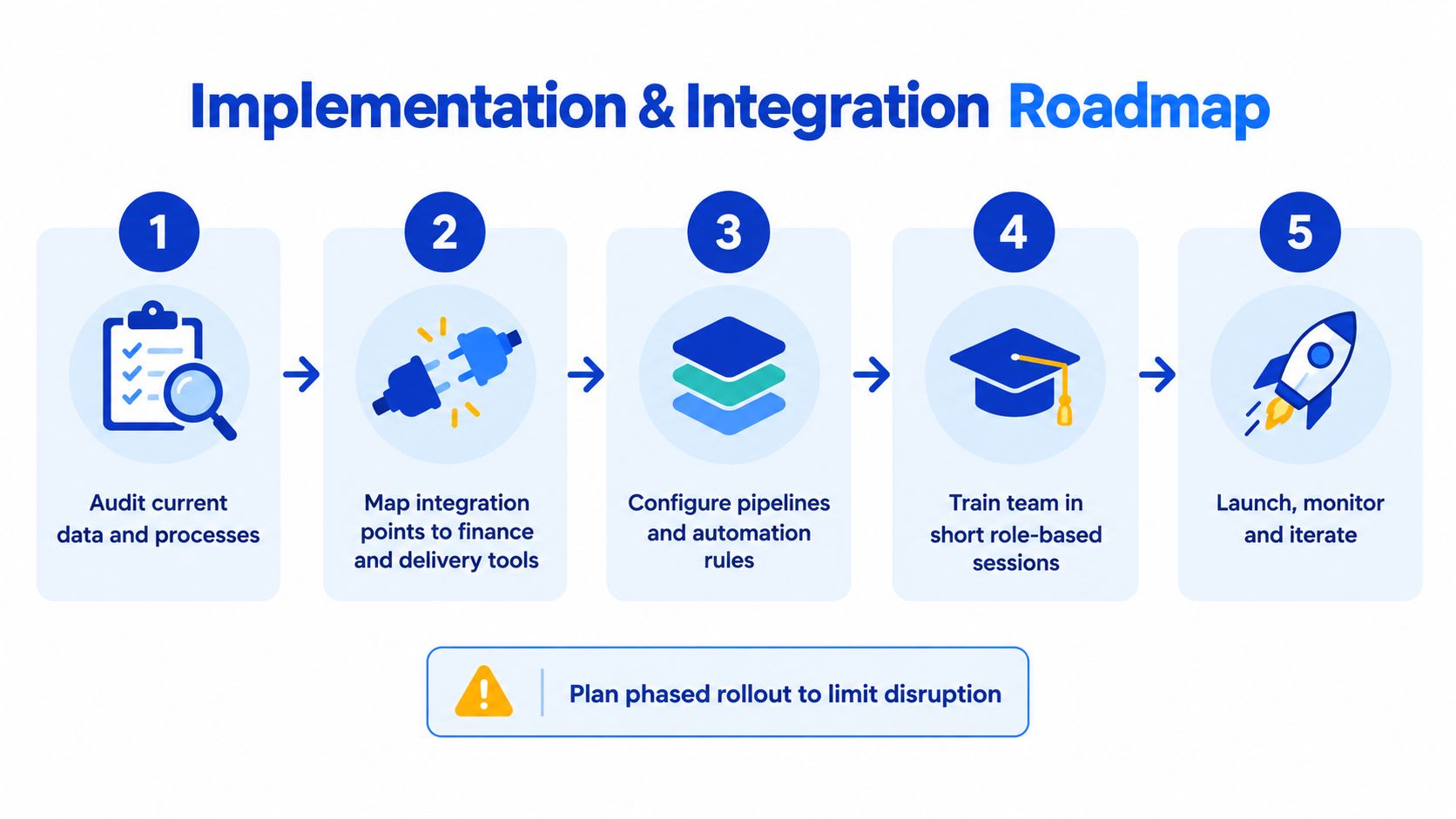
A practical rollout has five stages:
- Audit current data and processes: Identify duplicate contacts, missing owners, inconsistent stages, spreadsheet dependencies, and manual handoffs.
- Map integration points: Confirm what must connect with accounting, email, calendars, project management, communications, and client onboarding tools.
- Configure the minimum viable workflow: Build the essential pipeline, required fields, notifications, and handoff automations before adding edge cases.
- Train by role: Salespeople, managers, delivery staff, finance, and IT need different views and responsibilities.
- Launch, monitor, and iterate: Review adoption, data quality, exceptions, and automation outcomes after go-live.
Design integrations around ownership
An integration should have a clear business owner. If the CRM sends billing information to finance, finance must define which fields are required and what counts as a complete handoff. If it creates delivery work, operations must own the template and the service-level expectations.
Use integration rules that are easy to inspect. A trigger should have one understandable purpose, and users should know what to do when it fails. Avoid automating a poorly understood process. Automation can make inconsistency faster.
Data governance matters just as much. Decide who can create fields, who can change stages, how inactive contacts are handled, and which system is authoritative for financial or client records. Without these rules, both monday CRM and HubSpot can become cluttered.
Teams needing help with connected workflows can assess monday.com integrations support, particularly when CRM activity must connect with delivery or finance processes. An experienced implementation partner should help with health checks, testing, role-based onboarding, and post-launch optimisation, not just build the first version and leave.
A sound rollout is deliberately boring. Start with the process people must follow every day, then add sophistication only when the data proves it is needed.
Evaluating Market Maturity and Local Support
Product maturity matters because established platforms give buyers more implementation patterns, community knowledge, and examples of how other teams solve common problems. NZ review-directory data shows strong ratings for both products, but HubSpot has a much larger local review base, about 4,484 to 4,487 reviews, compared with 466 for monday CRM (NZ CRM review listings).
That difference doesn't prove one product is better. It does suggest that HubSpot has a broader history of use and more publicly visible implementation experience in NZ listings. monday CRM's smaller review footprint points to a more concentrated user base, which may be perfectly acceptable if your requirements favour flexible, cross-functional workflows.
Match maturity with support capacity
A mature market footprint can reduce uncertainty, but it doesn't remove the need for local expertise. NZ businesses often need help translating a generic platform into local finance processes, existing software, privacy expectations, and practical team habits. A large ecosystem helps only when you can find support that understands your operating model.
Use this decision matrix:
| Your team's operating profile | Recommendation | Reason |
|---|---|---|
| Marketing has defined ownership and needs connected campaign, sales, and service data | HubSpot | Its broader customer-platform model supports deeper revenue alignment |
| Sales and delivery share responsibility for client outcomes | monday CRM | Visual work management makes handoffs easier to represent |
| The business already runs projects and operations in monday.com | monday CRM | Users avoid adopting a separate front-office environment |
| Leadership wants a recognised platform with extensive market examples | HubSpot | The larger NZ review footprint provides more external benchmarking |
| The team has no CRM administrator and needs a straightforward first implementation | monday CRM | A focused workflow can be easier to introduce across departments |
| The team expects complex marketing operations later | HubSpot | Its architecture is better suited to a marketing-led expansion path |
Support quality should be tested before purchase. Ask each vendor or partner how they handle data migration, workflow errors, permissions, integrations, and reporting changes. Request examples relevant to your business, not generic product tours.
For a 10 to 50 person team, local implementation capability may matter more than a feature checklist. The platform must fit the people who will configure it, maintain it, and rely on its data during a busy customer handoff.
Making the Final Decision and Planning Next Steps
My recommendation is clear. Choose monday CRM if your immediate problem is fragmented work between sales, operations, delivery, finance, or IT. Choose HubSpot if your immediate problem is connecting an established marketing engine with sales and service.
Don't buy based on a broad demonstration. Run a controlled pilot with representative users and a real process.
- Use real opportunities: Import a manageable sample of active deals, including straightforward and difficult examples.
- Test the handoff: Move one opportunity from qualification through sale and into delivery or finance.
- Measure behaviour: Track whether owners, stages, next actions, and required fields stay current.
- Check management visibility: Ask whether a leader can answer pipeline questions without requesting separate spreadsheets.
- Test failure handling: Deliberately inspect what happens when required information is missing or an integration doesn't run.
- Review user friction: Ask the most sceptical participant what they would avoid updating.
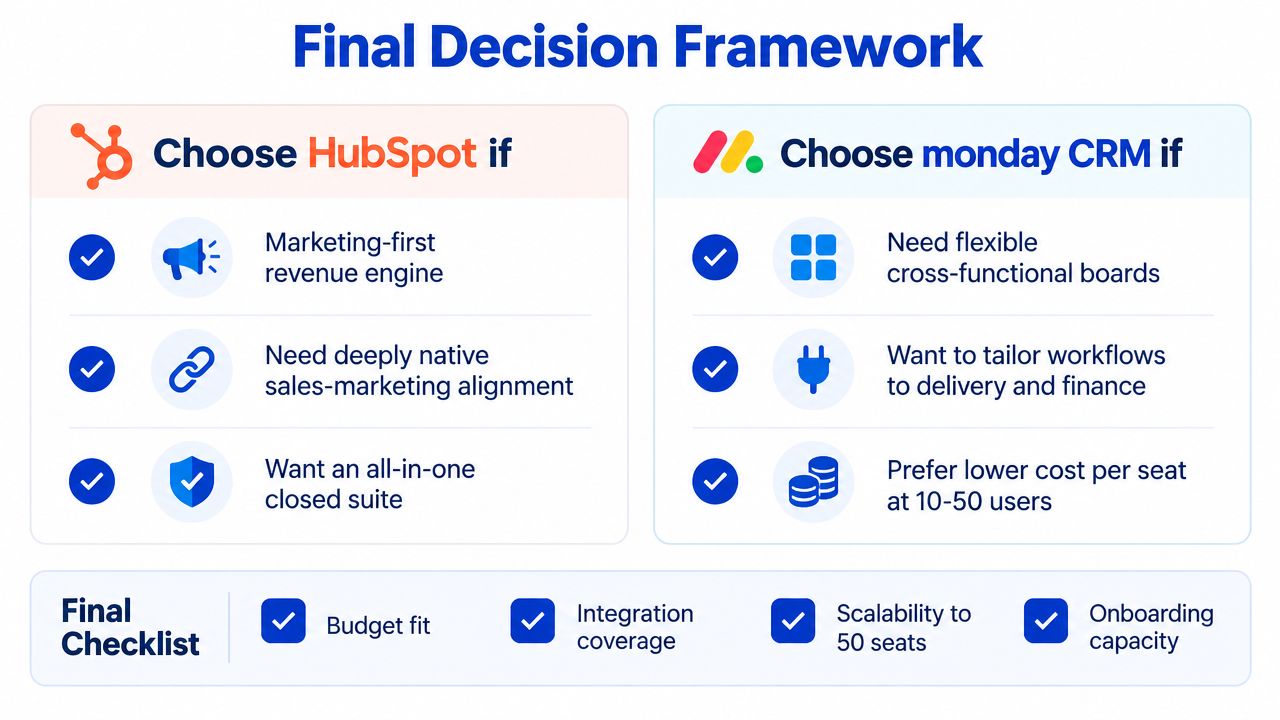
At the end of the pilot, choose the platform that creates reliable daily behaviour with the least administrative resistance. Feature depth matters, but adoption determines whether leadership gets a trustworthy view of revenue and whether delivery receives the information it needs.
Wisely helps NZ teams design, implement, and support monday.com workflows, including CRM structures, integrations, training, and ongoing optimisation. If you need to compare monday CRM and HubSpot against your actual sales-to-delivery process, visit Wisely to discuss a practical rollout plan.