You're probably already doing more finance work than you should.
Sales come in. Bills go out. Payroll clears. GST and tax deadlines keep appearing. Your bookkeeper keeps the records tidy, your accountant files what needs filing, and yet you still end up asking the same questions: why is cash tighter than expected, which jobs or clients are profitable, and can the business afford the next hire, system upgrade, or growth push?
That's the point where many NZ business owners realise the issue isn't effort. It's the lack of financial leadership between day-to-day bookkeeping and year-end accounting. A business can be busy, profitable on paper, and still make decisions too late because no one is actively steering cash flow, forecast risk, and capital planning in real time.
Why More NZ Businesses Are Choosing a Virtual CFO
A common pattern shows up in growing businesses. The owner reviews the P&L after month end, notices margin pressure, then discovers that revenue isn't the problem. It's timing. Debtors are slow, supplier payments hit early, tax obligations are coming due, and no one has pulled those moving parts into one forward view.
That situation isn't unusual in New Zealand. It reflects how the economy is built. According to data referenced from New Zealand's Ministry of Business, Innovation and Employment, firms with fewer than 20 employees make up about 97% of all enterprises, while SMEs account for around 28% of GDP and almost 30% of employment in New Zealand, which makes fractional finance leadership a practical fit for a very large share of the market (MBIE data reference).
Why this matters in practice
Most of those businesses don't need a full-time senior finance executive sitting in the office every day. They do need someone who can:
- Translate numbers into decisions so hiring, pricing, and purchasing don't rely on instinct alone
- Build planning discipline around cash flow, budgets, and runway
- Create management rhythm with reporting that supports action, not just record-keeping
That's where virtual CFO services make sense. They fill the gap between historical reporting and commercial decision-making.
A virtual CFO becomes useful when the business has outgrown reactive finance, but hasn't reached the point where a full-time CFO is justified.
For owner-led firms, this often starts with a practical need rather than a strategic ambition. They want better visibility before making a call on stock, a new contract, debt, or expansion. Over time, that finance support usually broadens into budgeting, scenario planning, board-style reporting, and sharper strategic planning support.
The shift NZ SMBs are making
The shift isn't merely outsourced finance for its own sake. It's recognising that good decisions need current numbers, clear assumptions, and someone accountable for turning financial data into operating guidance.
That's why virtual CFO services have moved from a “nice to have” idea to a working model for growth-stage NZ businesses.
Understanding Virtual CFO Services
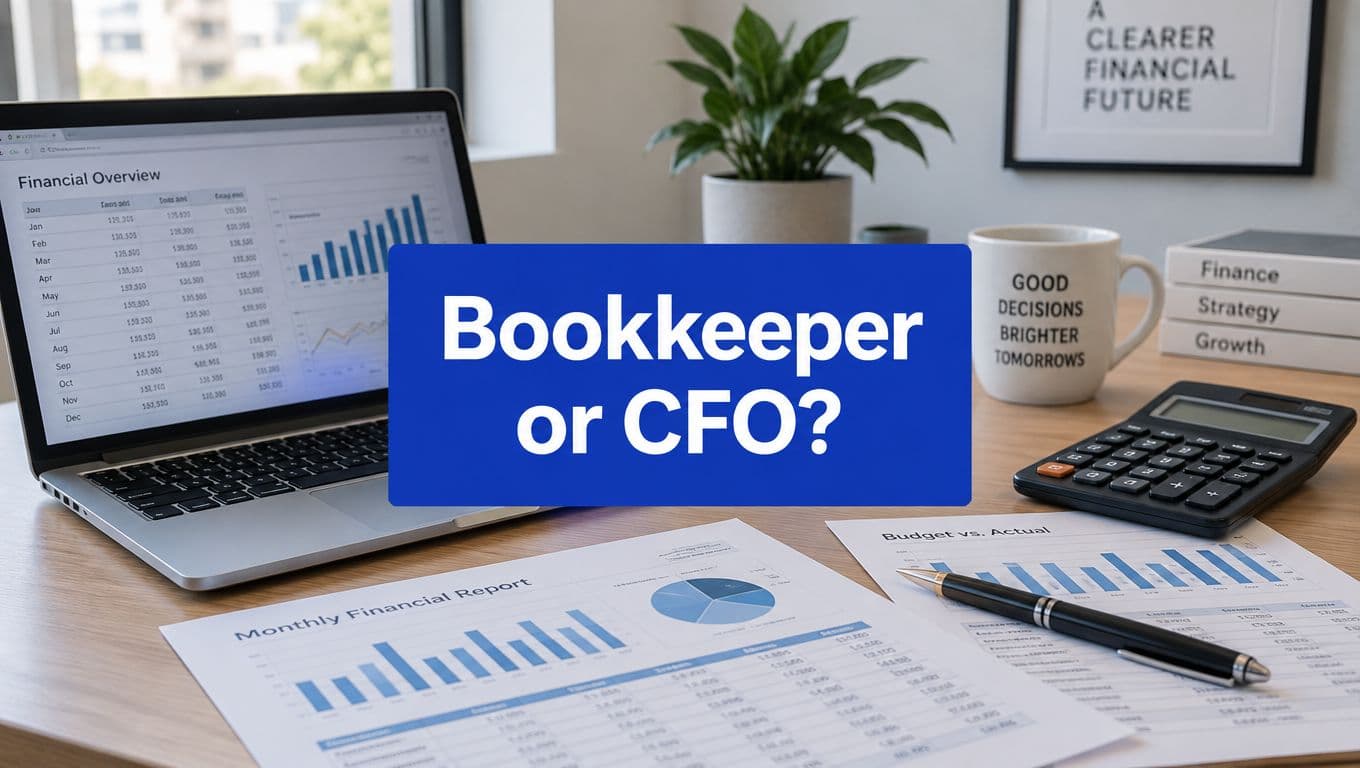
A useful way to think about it is this. Your bookkeeper records what happened. Your accountant reports and handles compliance. Your virtual CFO helps you decide what to do next.

The role in plain terms
A virtual CFO is a senior finance partner who works with the business on a part-time, fractional, or project basis. The role is forward-looking. Instead of stopping at reconciliations, tax filings, and statutory accounts, a virtual CFO uses that underlying data to guide decisions on cash, margins, forecasting, risk, and growth.
Core value: Virtual CFO services make senior financial thinking accessible to businesses that need strategic guidance but don't need a permanent CFO hire.
That distinction matters because many businesses think they have a “finance setup” when what they really have is a compliance setup. Compliance is essential, but it won't tell you whether your current pricing supports margin, whether your pipeline converts fast enough to cover upcoming obligations, or what happens if one major customer pays late.
Where accountants and CFOs differ
A strong accountant is critical. So is a strong bookkeeper. But the work is different.
| Role | Primary focus | Typical output |
|---|---|---|
| Bookkeeper | Transaction accuracy | Clean ledgers, reconciliations, organised records |
| Accountant | Compliance and historical reporting | Financial statements, tax work, reporting accuracy |
| Virtual CFO | Forward planning and business decisions | Forecasts, budgets, scenarios, KPI analysis, funding guidance |
A virtual CFO doesn't replace either of those roles. They sit above them and turn the data into an operating view of the business.
What businesses usually notice first
The first visible change is often not a complex strategy model. It's clarity.
Instead of waiting until month end to understand what happened, leaders start looking at current trading, expected cash movement, margin trends, and forecast variance. Decisions become less reactive because finance becomes part of weekly operations rather than an after-the-fact review.
That's why the best virtual CFO services feel less like advice in isolation and more like having a financial co-pilot. Someone is watching the instruments while the owner keeps flying the business.
Key Deliverables of a Virtual CFO
Business owners often hear broad phrases like “financial oversight” or “strategic guidance”. Those labels aren't helpful unless they translate into work you can see, use, and challenge.

The deliverables that matter most
In New Zealand, cash-flow stress is a material SME risk, so the highest-value use case is often working-capital control. That typically includes improving tax timing, tightening debtor collection cadence, and running a weekly 13-week cash forecast to shorten the decision loop (cash flow and working-capital focus).
That's why the best virtual CFO services produce tangible outputs such as:
A rolling 13-week cash flow forecast
This becomes the short-term control tower. It shows expected receipts, committed outflows, tax timing, payroll pressure, and likely pinch points before they become emergencies.A live budget with forecast updates
Not a static annual spreadsheet that gets ignored by February. A useful budget changes as assumptions change. If you want a practical primer on the mechanics, it helps to explore budgeting and financial forecasting before evaluating providers.Monthly management accounts with commentary
Good reporting explains variance, not just totals. The question isn't whether revenue moved. It's why margin shifted, what drove overhead changes, and which corrective actions follow.KPI dashboards for decision-making
These usually track margin, cash position, forecast versus actual, and business-specific commercial indicators. The output should help leaders act quickly, not spend meetings decoding spreadsheets.Profitability analysis by customer, service, or product
Many businesses know their total revenue but not where profit is generated. A virtual CFO should isolate the commercial drivers that deserve more investment and the work that drains capacity.Scenario models
These test decisions before money is committed. What happens if sales slip, headcount increases, pricing changes, or payment terms stretch?
What works and what doesn't
What works is simple enough to use every week.
What doesn't work is overbuilt reporting that looks impressive and gets ignored. I've seen businesses spend energy creating complex models while still lacking a basic weekly cash view. That's backwards. Start with the tools that control risk and improve timing. Build complexity only when it supports a real decision.
If the reporting pack doesn't change behaviour, it's administration, not finance leadership.
A capable provider should also support better management reporting practices, because reporting is where many engagements either become operationally useful or drift into theory.
A good deliverable passes one test
You should be able to answer three questions faster than before:
- What's happening right now
- What's likely to happen next
- What decision should we make because of it
If a virtual CFO engagement can't improve those answers, the service scope is wrong.
Virtual CFO Pricing and Engagement Models
Most businesses don't struggle with the idea of a virtual CFO. They struggle with how to buy the service properly.
The right model depends less on price in isolation and more on how often the business needs input, how complex the operation is, and whether the problem is ongoing or milestone-based. A founder preparing for funding needs a different arrangement from a service business that mainly needs monthly planning discipline and cash visibility.
Monthly retainer
A retainer is the most practical model when finance leadership needs to become part of the normal operating rhythm.
This usually suits businesses that need recurring support with forecasting, management reporting, cash reviews, leadership meetings, and periodic scenario work. The benefit is continuity. The CFO partner learns the business, understands timing patterns, and can spot issues faster because they're close to the numbers over time.
The trade-off is scope discipline. If the engagement isn't defined clearly, retainers can drift into a vague “available when needed” arrangement that frustrates both sides.
Project-based work
Project pricing makes sense when the outcome is specific.
Examples include rebuilding a budgeting process, preparing for debt or capital raising, designing reporting packs, cleaning up finance systems, or setting up dashboards and workflows. This model works well when the business has a clear start point and a defined end state.
It's less effective when the underlying problem is ongoing decision support. A one-off project can fix structure, but it won't replace regular financial leadership.
Hourly advisory
Hourly work fits ad hoc needs. It can be useful when an owner wants a second view on a contract, pricing change, system choice, or a short-term issue.
The advantage is flexibility. The downside is fragmentation. Finance usually improves when someone is accountable for the whole picture, not just isolated questions.
What typically drives pricing
Even without quoting rates, the main pricing drivers are usually easy to identify:
| Factor | Why it affects scope |
|---|---|
| Business complexity | More entities, service lines, or reporting needs require deeper analysis |
| Transaction volume | More data usually means more controls, more review, and more exceptions |
| Leadership cadence | Weekly meetings and ongoing decision support take more involvement than monthly reviews |
| Systems maturity | Messy data and disconnected tools increase implementation effort |
| Strategic requirements | Funding, banking, and board-style reporting demand more senior input |
A practical way to think about this is to compare finance support models the same way you'd compare software capacity. Businesses already do this with operational tools, including AI employee management plans, where the question isn't just monthly cost. It's whether the plan fits the operating load.
Buy for decision quality and operating fit, not for the lowest visible fee.
The wrong engagement model often looks cheaper at the start and more expensive later because the business still lacks consistent visibility.
How to Choose the Right Virtual CFO Partner
Choosing a provider isn't only about credentials. It's about whether they can improve how the business runs.
A polished proposal can still produce weak outcomes if the provider can't work with your systems, can't communicate clearly with non-finance leaders, or treats reporting as a monthly document exercise rather than an operating tool.
To evaluate fit properly, start with a checklist.

Questions worth asking
Do they understand your commercial model
A provider doesn't need to know your industry jargon perfectly on day one, but they do need to understand how your business makes money, where margin leaks, and what operational decisions drive financial outcomes.How do they structure reporting and cadence
Ask what happens weekly, monthly, and quarterly. If the answer is vague, the service will probably be vague.What tools do they work with
Finance leadership now depends on data flow, not just spreadsheet skill. Ask how they handle dashboards, source data, workflow visibility, and system integration.How do they define success
If success is described only as “better insights”, push further. The answer should include earlier visibility, tighter control, faster decisions, and clearer accountability.What happens in the first month
A serious provider can describe the first actions clearly. Usually that means reviewing data quality, cash visibility, reporting gaps, and immediate risk areas.
This short video gives a useful overview of what to look for in the role and the relationship:
How to think about ROI
A lot of business owners ask the wrong question. They compare virtual CFO services with the cost of a full-time CFO and stop there.
The more useful comparison for most NZ owner-led firms is virtual CFO versus no finance leadership at all. The main payoff is often earlier cash visibility and better scenario planning, especially where formal cash buffers and structured planning are still weak (ROI framing for NZ firms).
That changes the buying logic. You're not only paying for advice. You're paying to reduce blind spots.
Signs of a weak fit
| Warning sign | What it usually means |
|---|---|
| Heavy focus on compliance only | They may be acting as an accountant, not a CFO partner |
| No clear reporting rhythm | You'll likely get irregular insight and delayed decisions |
| Generic dashboards | They may not understand what drives your business specifically |
| Hard-to-explain language | Communication with your leadership team will suffer |
A good virtual CFO should make the business easier to run, not make finance sound more complicated.
The right partner helps you move faster with more confidence. The wrong one produces extra reports and very little control.
Implementing Your Financial Operating System
The strongest virtual CFO engagements don't stop at advice. They build a financial operating system.
That means finance isn't sitting in a disconnected spreadsheet file, an accounting package, and a few conversations in someone's inbox. It's organised across tools, workflows, and reporting so the leadership team can see what matters and act on it.

What a modern setup looks like
The technical benchmark for a useful virtual CFO stack is a cloud-first, dashboard-driven finance operating model. That usually includes cloud accounting software, possible ERP integration, and KPI dashboards that show margin, runway, and variance versus forecast in near real time, turning reactive reporting into continuous monitoring (cloud-first finance operating model).
For many NZ SMBs, that's where platforms like Xero and monday.com become highly relevant together.
Xero holds core financial records. monday.com can sit around that data as a work management layer for approvals, budget ownership, debtor follow-up, forecast actions, project visibility, and cross-functional accountability. Done properly, the finance function stops being a monthly report and becomes an active operating system shared by finance, operations, and leadership.
Where monday.com changes the game
A lot of finance problems are workflow problems.
Invoices aren't chased consistently. Purchase approvals happen too late. Hiring decisions aren't linked back to budget ownership. Project teams don't see commercial performance until after the damage is done. A work management platform can connect those actions to financial outcomes.
That's why a modern virtual CFO setup often includes:
- Task-linked financial accountability so actions from reporting reviews are assigned and tracked
- Centralised operating visibility across jobs, departments, and deadlines
- Structured approval flows for spend, hiring, or project changes
- Dashboard layers that bring finance and operational signals into one view
One practical route is combining Xero with monday.com through a structured Xero integration for monday.com workflows, so finance data and business process management don't live in separate worlds.
A practical implementation sequence
A working implementation usually follows a pattern:
Assess the current state
Review reporting gaps, data quality, workflow bottlenecks, and decision pain points.Design the management model
Decide which KPIs matter, who owns them, how often they're reviewed, and where actions are captured.Connect the systems
Link accounting data, dashboards, and operational workflows so reporting becomes usable day to day.Run a regular cadence
Weekly cash reviews. Monthly performance reviews. Forecast updates when assumptions change.Refine continuously
Remove reports no one uses. Add visibility where leaders still make decisions with guesswork.
The goal isn't more reporting. It's one reliable view of financial reality that the business can actually operate from.
This is the point where virtual CFO services become more than outsourced advice. They become infrastructure for how the business plans, monitors, and responds.
Common Questions About Virtual CFO Services
The questions below come up often once business owners understand the role more clearly.
| Question | Answer |
|---|---|
| How is a virtual CFO different from my accountant? | Your accountant usually focuses on compliance, statutory reporting, and historical accuracy. A virtual CFO focuses on forward-looking decisions such as forecasting, cash planning, margin analysis, scenarios, and management reporting. Both matter, but they solve different problems. |
| What should a virtual CFO do first? | The first priority is usually to improve visibility. That often means establishing a short-term cash view, checking the reliability of current financial data, identifying reporting gaps, and agreeing on the KPIs and meeting cadence the leadership team will actually use. |
| Can a virtual CFO help with funding or banking conversations? | Yes. A virtual CFO can help prepare forecasts, explain the numbers behind the business story, structure reporting for lenders or investors, and pressure-test assumptions before those conversations happen. Their value is often highest when the business needs a credible financial narrative, not just a compliance file. |
A good finance partner should leave you with fewer unknowns, tighter control over cash, and better-quality decisions across the business. If your current setup gives you reports but not direction, that's usually the signal that the business needs more than bookkeeping and year-end support.
If you want to turn finance from a reporting function into a working operating system, Wisely provides virtual CFO support alongside process automation, reporting design, and connected workflow implementation for NZ businesses using tools such as Xero and monday.com.